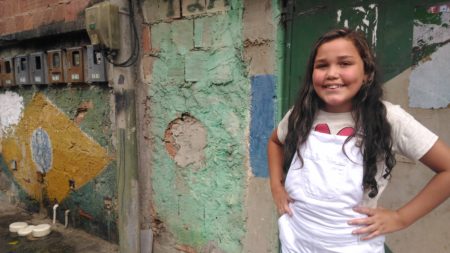
LAÍS MARIA PEREIRA da Silva, 12, was born and raised in a part of Rio de Janeiro called Complexo da Maré , which comprises one of the biggest set of favelas—or shanty towns—in this Brazilian mega-city. Despite her youth, this girl is already well acquainted with violence, despair, and death. Her part of town is home to 17 separate communities with a total of 130,000 inhabitants. In addition to horrible living conditions—where a piece of bread often makes up a meal—the people live under the constant threat of violence.
The favelas of Rio are controlled by various criminal factions that each run drugs through the alleys that make up the neighborhood infrastructures that serve as closely-guarded transportation networks. Complexo da Maré is among the most dangerous areas in the city because it is run by two major criminal groups, Comando Vermelho (“Red Command”) and Terceiro Comando Puro (“Pure Third Command”), with each dominating opposite sides of the area. They are engaged in a constant batt in efforts to expand their respective territory.
Laĺs lives in a favela called Baixa do Sapateiro, on a street called Divisa Street, which means border—and the street got its name precisely because it marks the border between the territories controlled by the two criminal organizations. “They stay in the alleys, exchanging gun fire. We have to lay down on the floor in our homes because no room is secure. The shots come from the front and from behind,” says Viviane Pereira, another resident of Complexo da Maré.
The violence does not only make Laís’ daily life difficult—it also clouds the outlook for her future. The schools in the area often need to cancel classes for security reasons. When there are no gun fights close to school but there is shooting going on near her house, her mother, says the girl, “has to call the teachers to warn us that we cannot leave the school; we’re often asked to study for tests another day.” The girl dreams of studying to be a doctor so she can help people—and so that she can make it possible for her family to move to a safer neighborhood.
The facades of the houses show the evidence of the state of war residents of Complexo de Maré have to contend with. Bullet marks of different sizes are evidence of the gangs’ firepower. In an effort to protect themselves, some people board up their windows with bricks to guard against stray bullets; others build underground rooms to shelter their families during shoot-outs. But no one is really safe. “When the shooting suddenly erupts, we run to the first house we see. Everyone around here knows everyone and understand the fear of these moments,” says Laís, who adds: “I’m afraid to get shot.”
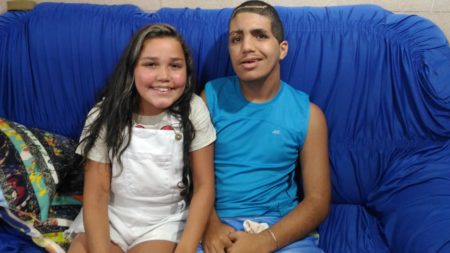
It was precisely at home that Laís’ family lived through one of the most harrowing moments of their lives. It was a typical afternoon; her cousin Ian, who was 12 at the time, was playing on the home’s small patio, as children are rarely allowed to play outside the confines of the home. Laĺs remembers: “Suddenly, a shooting started. Before Ian could run inside, he got shot. My aunt, Ian’s mother, ran downstairs and found her son on the ground, with a puddle of blood around his head.”
The bullet reached the right side of his brain. Family members had to wait for the shootout to end before they were able to take him to the hospital. He survived. But his injury required many surgeries, one of them included removing part of Ian’s brain. As a result, some of his motor skills were impaired; the surgery also affected his ability to talk.
“I was very sad, very touched when everything happened to my cousin,” says Laís, adding: “today, seven years later, he plays with us, but he cannot run.” Ian is confined to a wheelchair and remembers very little about what happened that day. But his family will never forget it. Laís, along with all her friends, live under a shadow of fear of getting hurt themselves, with even a worse outcome.
“I like to play… run with my friends,” Laís continues, although, she adds: “when we are in the streets or alleys near here, I’m afraid of getting hit, or that a shot hurts one of my friends.” In these almost unbearable circumstances, it’s faith in God that keeps Laís and her family going. It would be easy to lose hope and give way to despair under the constant threat of violence.”
However, speaking with the purity of a child, Laís teaches those who would hear an important lesson: even amidst the shootings, she says, “it’s possible to keep a bullet-proof faith and to be a sign of hope to the others. I always pray to God to support Ian’s parents, my uncle and aunt, and that nothing bad will happen to my friends.”
—Isis Maria Vieira