Pope Leo XIV traveled to the birthplace of St. Frances Cabrini, highlighting the ongoing need to minister to migrants
As the United States of America prepares to celebrate its 250th anniversary as a nation, the first American pope traveled to northern Italy to pay tribute to the first canonized American citizen.
“I am here to pay homage to Mother Cabrini, patroness of migrants, the first saint of the United States of America, born here, in Sant’Angelo Lodigiano, in 1850, and died in Chicago, my hometown, in 1917,” Pope Leo XIV said Saturday in the Church of SS. Anthony Abbot and Francesca Cabrini.
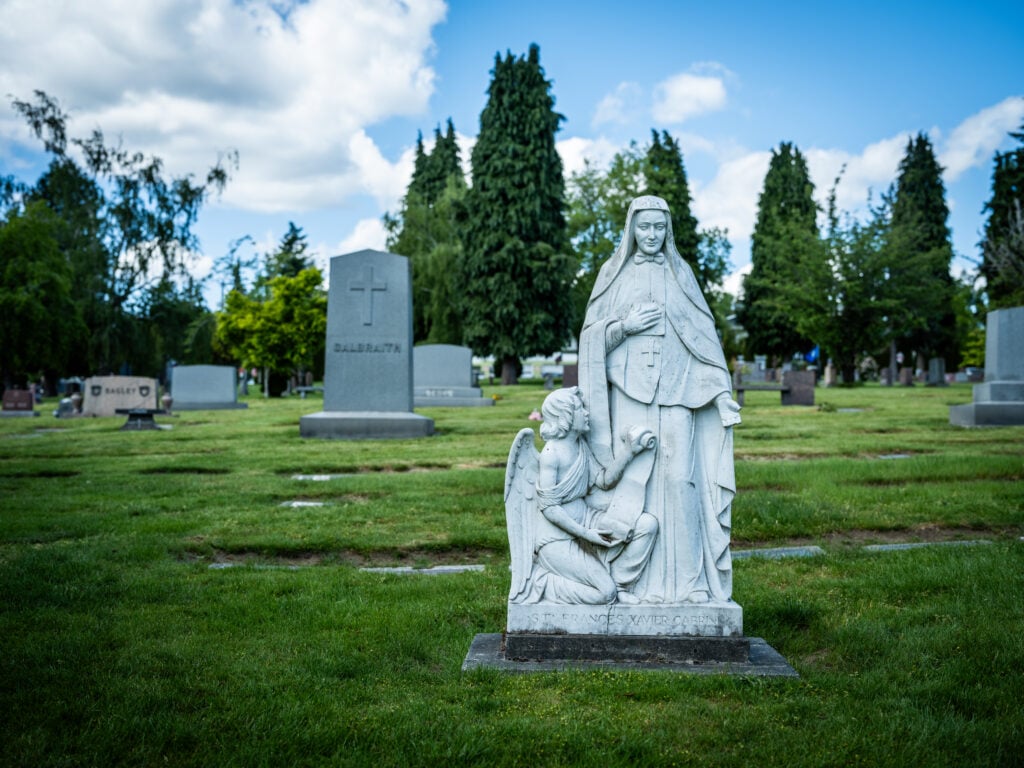
It was the last Pope Leo – Leo XIII – who sent Mother Cabrini to Italian immigrants in the United States.
“Not to the East but to the West,” Pope Leo XIII told the young nun, who had expressed her desire to evangelize China.
In 1889, the missionary and six of the sisters in the religious order she founded – the Missionary Sisters of the Sacred Heart of Jesus — sailed to New York. “Within days of her arrival, Mother Cabrini organized catechism classes and schooling for the children,” according to the St. Francis Cabrini Shrine in New York. “She and the sisters knocked door to door through rough neighborhoods, facing humiliating insults to gather funds to do their work. Their convent quickly became a haven for children from the notorious Five Points neighborhood. An orphanage was established, followed by parochial schools and a hospital.”
In 1909, Mother Cabrini became a naturalized citizen.
Requests for Mother Cabrini’s help poured in from other cities in the United States, Europe, and Central and South America. “Over the course of 34 years Mother Cabrini established an astonishing 67 hospitals, orphanages, and schools. Her energy was fueled by an intense focus on serving Jesus in whatever he asked of her,” says the Cabrini Shrine.
Mother Cabrini died Dec. 22, 1917, in one of the hospitals her order founded — Columbus Hospital in Chicago. Pope Pius XII canonized her in 1946 and in 1950 designated her “Patroness of Immigrants.”
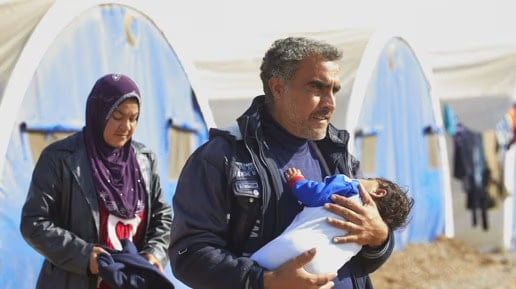
Migration is perhaps even more of an issue today than it was in the late 19th century. Leo XIV addressed the topic in his discourse on Saturday.
“Let us ask ourselves: if Mother Frances lived today, what would her missionary soul say to her? Or rather, what would the Heart of Christ say to her heart as a woman consecrated to Him and to the service of His Kingdom? And what would a Pope like Francis, who, the son of Italian emigrants, has made service to migrants one of the key points of his pontificate, have asked of you?”
Dear friends, Pope Francis wanted his fourth encyclical, Dilexit nos, which was his last, to be dedicated to the “human and divine love of the Heart of Christ,” that is, to that mystery of infinite charity which is the only true “engine” of St. Cabrini’s life, of all that she achieved and, even more, of how she did it. In this encyclical, Pope Francis writes: “The timeliness of devotion to the Heart of Christ is particularly evident in the evangelizing and educational work of numerous religious congregations of women and men which have been marked from their origins by this Christological spiritual experience.”
Leo noted that in his own Apostolic Exhortation Dilexi te, he refers to Mother Cabrini in a section that speaks of charity in the form of “accompanying migrants.”
“Her maternal heart, which did not give itself peace, reached them everywhere – the emigrants – in the hovels, in the prisons, in the mines.” She herself wrote: “No work will be too difficult, no land too far away, no person too wounded for the love of the Heart of Jesus and for all those invited to be bearers of Christ’s love in the world.”
The pope urged people to read Mother Cabrini’s writings – letters, travel diaries, and retreat notes — which he said are “full of passion for Jesus and for the mission.”
“Her soul was at once contemplative and active,” he commented. “She was immersed in the love of the Heart of Christ, and this gave her an extraordinary capacity for work and strength of spirit, consistent with the Pauline motto she had chosen for the Institute: ‘I can do all things through him who strengthens me’ (Phil 4:13).”
–John Burger