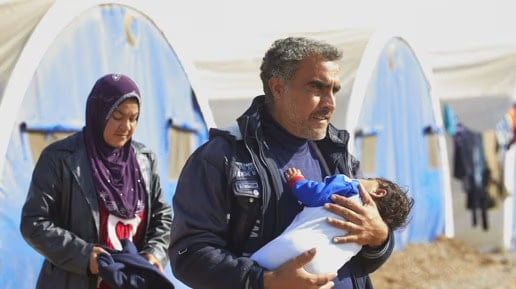
The Archbishop of Panama spoke to Aid to the Church in Need (ACN) about his experience in the Darién Gap, one of the most inhospitable migratory routes in Latin America. Archbishop José Domingo Ulloa highlighted the urgent need for attention and action in the face of terrible conditions that thousands of migrants face.
“We feel we must raise our voice at the growing humanitarian crisis in the jungle region of the Darién Gap, and the terrible conditions of death and vulnerability these migrants face,” said Archbishop José Domingo Ulloa, during a visit to the main office of the Aid to the Church of Need (ACN). “An incalculable number of people lose their lives, and many of their bodies are never retrieved.”
The Darién Gap is a very dangerous jungle that forms the natural border between Colombia and Panama, and one of the most difficult routes to the United States. Thousands of people attempt this journey, especially Venezuelans, Ecuadorians, Colombians, and Haitians, and intercontinental migrants desperate for a better life.
Archbishop Ulloa travelled to Darién in March, to participate in a gathering of bishops from the border dioceses in Colombia, Costa Rica, and Panama, to discuss the situation. The meeting was supported by ACN. “The sight of their faces was heartbreaking,” the bishop said. “Migration has the face of a woman: around 40 percent of the people who go this way are women. And it also has the face of children, of entire families…it tears at your soul to see it,” he explained. In 2023, more than 517,000 people crossed the Darién region, 113,000 of whom were children, including thousands of unaccompanied minors.
This path is plagued with danger. Besides the tropical illnesses and wild animals, there are also armed gangs and human traffickers, who “make a living off the desperation of our brothers,” the Panamanian prelate said. “We want to use new digital technology to create an awareness campaign. I believe this is necessary. What are the dangers they will face if they try to cross? Because in this context, many people use the media to tell migrants that it will be easy-going, when that isn’t true at all. It’s not easy. We understand the dramatic reasons that lead people to leave their own country, but I believe that we need to draw attention to the many dangers they will face on the way.”
Pope Francis: “A real Way of the Cross”
At the end of the meeting, the participating bishops issued a joint statement on the migration crisis, stressing the need to “listen, discern, and act on our pastoral responsibilities.” Furthermore, they said, “in a society such as ours, exclusion, xenophobia, discrimination, and indifference must be counterbalanced by the construction of a culture of encounter, woven from hospitality and [a spirit of] welcome.”
Pope Francis sent the participants a message of support, in which he described the migrants’ route through the Darién Jungle as “a real Way of the Cross.”
“When we met at the end of March,” Archbishop Ulloa said, “the Pope sent us words of encouragement. I still get emotional when I recall the Pope’s words: ‘I too was a migrant.’ And he invited us bishops to accompany him and to wipe the tears from the face of the suffering Christ. It was a marvellous experience. Now we use this message a lot, so the migrants know that the Pope carries them in his heart.”
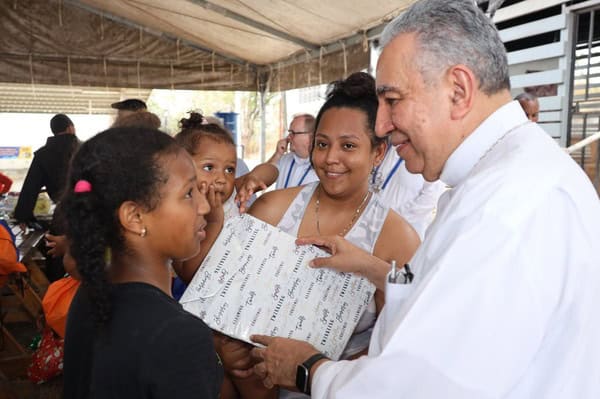
Archbishop Ulloa added that “most of these migrants are people of faith. We want to be present as a Church, for example, by setting up stations for psychological support for the women, many of whom are abused during the crossing and need special treatment and attention to overcome trauma. And the children need special care, too. We need places where a priest or a woman religious can give them strength and consolation, and heal their wounds,” the bishop told ACN.
In his opinion, all pastoral agents in the Church should gain awareness of migration, beginning with the bishops, priests, and religious, but also including the laity. “Sometimes, in our countries, we don’t understand the phenomenon of migration, but we should walk in the shoes of the migrants. One of the goals is to create awareness among all our pastoral agents, so that they are wired to see the face of God in these migrants, and not to treat them as a threat. We have to integrate them into the community.” He also said that “in Panama, many of those who come were once catechists, and they end up being integrated as catechists in the parishes here. But that entails a complete transformation. How can we blend the richness they bring with the richness of the host country, so that in the end we can say: ‘We are all brothers?’”
“I would like the migrants to find the Church as a mother, healing wounds. As a Church, we want to be there, to be a reference point, to be able to provide a spiritual and psychological welcoming. We must stress that migrants are not just numbers, they are people.” The Panamanian bishop concluded by thanking ACN for its help and asking for prayers for his endeavor. “The first and most important help is the power of prayer, which gives us strength. From that perspective, we are one body. And as such, when even the smallest member suffers, the whole body suffers, and we need to make that suffering our own.”
—Maria Lozano & Lucia Ballister