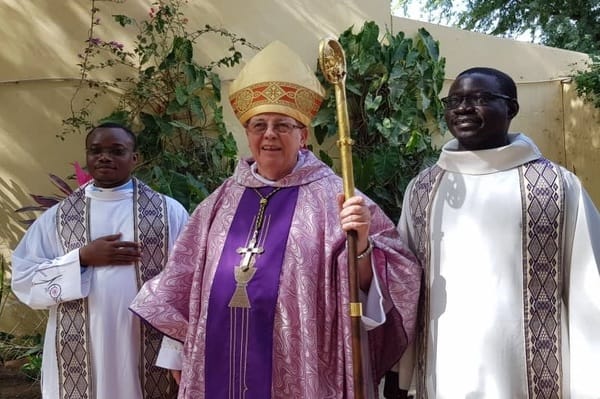
“Only God knows how many Catholics there are in Mauritania,” says Bishop Martin Happe with a smile. In a conversation with Aid to the Church in Need (ACN), he looks back on 50 years of his missionary work in Africa, first in Mali, and then, for the last 28 years, as the only bishop in Mauritania, whose 4.5 million inhabitants are almost 100 percent Muslim. “They are automatically Muslim,” he explains. “Just like in my childhood, you were automatically Christian in my home country.”
According to the bishop, Christians who come to Mauritania from other countries can live their faith freely. They are not persecuted here, like they are in other parts of Africa. Admittedly, he says, it is legally forbidden to convert from Islam to Christianity, but even if the ban were removed, “there would be no big wave of conversions.”
“We want to show that God loves all people”
The number of Catholics who go to Mass or have their children baptized is “not higher than in a parish in Western Europe,” Bishop Happe says. The members of the Catholic community come from about 50 nations. And Mauritania, which is twice the size of Germany, is served by 12 priests, three religious, and 30 nuns. But despite its small size, the Catholic Church in Mauritania has big aspirations, the bishop stresses: “As Catholics, we are there for all Mauritanians. Through our activities and the way we live together, we want to show that God loves all people.”
There are lots of opportunities for this in Mauritania. Many refugees come from neighboring countries, which creates social tension, especially when refugees belong to opposing ethnic groups. An example of a small success story is that people from different sides of the civil war in Ivory Coast have joined together in a church choir. “I said to them: ‘Do something together!’ And the choir has been there for ten years now,” Bishop Happe says.
Commitment to the weakest
One major social challenge is the growth of cities in Mauritania. In the past, most citizens lived on rearing livestock. But according to the bishop, periods of drought have increased since the 1970s, driving more and more people to the cities. “Many people lived in misery there,” he says. “Mothers were unable to care for their children. The Church has become active in this field, which benefits the whole of society. Nuns have set up little stations on the edges of the city, where they provide milk products and hygiene training for mothers.”
The Church is also dedicated to the care of children with disabilities, who are often hidden and neglected by their families. Bishop Happe is proud that the Church has built a nurturing center for them. “Little miracles take place there. Children who couldn’t move can run again because they have been cared for properly.”
“Without ACN, things would not work”
To continue this mission in Mauritania, the diocese depends on the generosity of the global Church, says Bishop Happe: “The nuns need support to be able to do their work. And we need vehicles to get to people, because our country is sparsely populated, and there are long distances to travel.”
Besides material help, he adds, prayer is also important: “I value ACN because I know that we get prayed for a lot there. It is important to have ACN and its donors on our side. Without it, things would not work.”
—Tobias Lehner