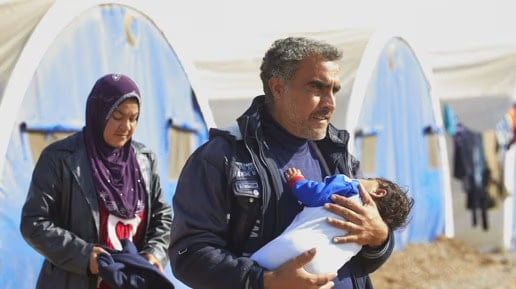
The Auxiliary Bishop of the Exarchate of Donetsk in Ukraine, Maksym Ryabukha, SDB, travels to see every person in his war-torn diocese. He asks for our prayers, especially for those he is unable to meet in person due to occupation or kidnapping risk.
The Archepiscopal Exarchate of Donetsk, the easternmost Greek Catholic diocese of Ukraine, is currently unable to access a large part of its territory. The Luhansk region is almost entirely occupied; the Donetsk and Zaporizhzhia regions are partially occupied; the Dnipro region is bombarded daily; and because of the war, which, in this region, began in 2014, the diocese’s seat was temporarily moved from Donetsk to Zaporizhzhia.
Until November 2022, several Catholic parishes and a Redemptorist monastery were still operating in the occupied territories, but in mid-November, two Redemptorist Fathers, Ivan Levitskyi, C.SS.R., and Bohdan Heleta, C.SS.R., one of whom suffers from a severe form of diabetes, were arrested by Russian troops and are still being held at an unknown location.
“Despite prayers, protests, and the Catholic Church’s efforts to contact those who are responsible, to find out how the priests are doing, there is still no news of the priests to this day,” says Bishop Maksym Ryabukha.
The bishop requested that Aid to the Church in Need (ACN) continue to ask all benefactors and friends to pray for the speedy release of Father Ivan Levitskyi and Father Bohdan Heleta.
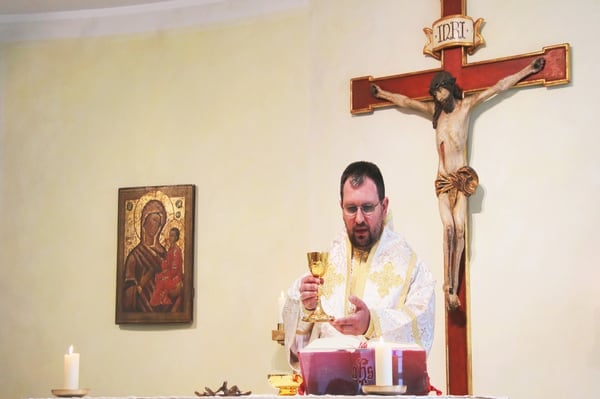
During a visit to ACN’s international headquarters in Germany, the Auxiliary Bishop testified that loneliness is a sign of the times in the occupied territories. Bishop Ryabukha says that he wants to be “the spiritual father not only of the freely accessible part of the Exarchate, but of the whole region,” where he was appointed bishop in November 2022. Therefore, he tries “to meet people in person and to give them material help and spiritual strength.”
Since the beginning of his episcopal ministry in December 2022, and thanks to an ACN-funded car, Bishop Ryabukha has traveled more than 30,000 miles to visit the people entrusted to him, strengthen those close to the front line, and bring them signs that the Church is still alive in Ukraine.
Clergy were thrown out of the occupied territories at the start of the war, and “today, there is not a single priest of the exarchate there,” says the bishop. Thanks to the provision of Mass stipends to the priests of the Exarchate of Donetsk by ACN, Catholics living in the occupied territories can pray and participate in the Mass through social media.
The auxiliary bishop explains that by receiving the generous support of ACN and sharing it with others in this time of war, “the Church in Ukraine is becoming a meeting place for people of more than one nation. This highlights the essence of being together: friendship does not mean the same way of thinking or seeing things; to be a friend is to live together, allowing the other person to be themselves, with their own culture, history, and beliefs.”
This is exemplified very concretely in the Exarchate of Donetsk. The bishop recalls visiting two elderly people in one house, who were not members of the same family: when an elderly woman lost her home in a bombing, an old man in the neighbourhood opened his door and shared his home with her. “The Church has established social centres for children, families, and the elderly, where people of different denominations come. In times of war, one does not think about what form God is believed to be; it is a time to pray together and be together in fellowship,” the bishop says.
Being a Salesian, and having dedicated his entire ministry to education, Maksym Ryabukha invites his flock to follow the example of young people. “Young people do not stop dreaming and do not give in to fatigue, and this is an inspiration for us,” the bishop says, expressing his gratitude and confidence.
Since the beginning of the war, ACN has supported the Churches of both Catholic rites in Ukraine with 353 projects, totaling over 10 million euros. The Catholic Church, in turn, provides important services to society, giving hope to many people.
—Mykolas Sotnicenka