George Akroush is the director of the Project Development Office at the Latin Patriarchate of Jerusalem. In an interview with Aid to the Church in Need (ACN), he speaks about the patriarchate’s plans for renewing pastoral work among Christians in the Holy Land, who are trapped by rising extremism.
The Latin Patriarchate of Jerusalem covers the territories of Palestine, Israel, Jordan, and Cyprus. Their situation is complex now, with growing communities in Israel and rapidly diminishing populations in Palestine and Jordan.
“In Israel, besides Palestinian Christians, we have two important vicariates: the Hebrew-speaking congregation – a group of 1,200 Catholics – and the Vicariate for Migrants and Asylum Seekers, which numbers approximately 120,000. This is why we say that despite all our challenges, including local Christians leaving the Holy Land, we are becoming larger and more diverse. But still, because the local Christians are leaving, we now comprise less than one percent of the total population,” said Akroush.
Over the past 30 years, ACN has been involved in more than 700 projects for Christians in Israel, Palestine, and Jordan, including over 100 in partnership with the Latin Patriarchate. But according to Akroush, this cooperation is about to be more significant than ever before. “ACN will support a major intervention with a special focus on the pastoral needs of the people. Surprisingly, despite our unique status as Christians descending from the first Christian community in the world, our people are far away from the Bible and its teachings, and there are major gaps between clergy and youth groups.
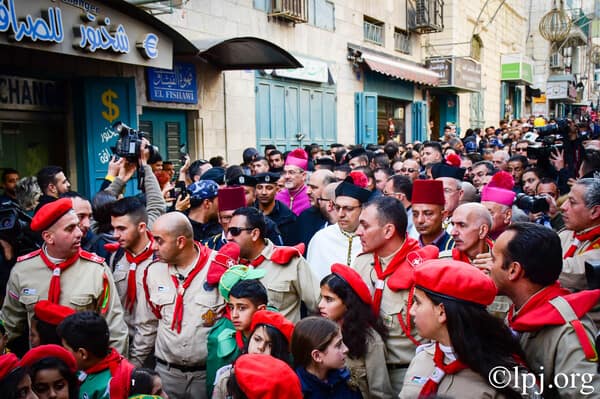
We have several Catholic scout groups, youth groups, and prayer groups, but they are very disconnected from the Church. We must be brave enough to admit that in the past, there was no real pastoral work, and that the Church’s engagement with youth groups was rather sporadic and fragmented. Yet the youth groups are the future of our Church community. The Patriarchate is aware of this, and with the support of ACN, we will launch a strategic program targeting youth groups in Jordan, Palestine, and Israel, including the Vicariate for Migrants and Asylum Seekers and the Hebrew-speaking congregation,” he explains.
The plan includes establishing youth chaplaincies and opening the Latin seminary to non-clergy. “For the first time in 170 years, you will find clergy sitting next to a scout leader, having lessons in biblical studies, philosophy, and Christian values. This is very important, and we are making history with ACN, because it is the first time we are embarking on larger-scale projects, instead of supporting more localized or sporadic projects.”
The Latin Patriarchate of Jerusalem also aims to reform the school curricula to help fight extremism and promote the acceptance of Christians in a more secularized society. “Despite our tiny number, less than one percent of the population, we still serve 40 percent of the Palestinian people. Despite our challenges, we offer the best schools, the best hospitals, and the best institutions for orphans, refugees, the elderly, and people with disabilities. The most important tool for change might be the Christian organizations affiliated with different Churches, especially the schools. The Church runs almost 200 schools in Palestine, Israel, and Jordan, and they teach hundreds of thousands.
We want the new generation of Palestinians to be open-minded and more accepting of others, especially Christians. We must employ this tool to change their way of thinking. Most of our students are Muslims, and this is a positive thing, since otherwise, they would go to more radical schools. Our schools have a duty to enlighten our students and to instill in them the Christian values of love, tolerance, and acceptance.”
Unfortunately, carrying out these projects is difficult. There is growing fundamentalism and hopelessness in Palestine, especially in Gaza, with no peace agreement on the horizon and widespread corruption in the public sector. And Israel continues to make life hard for Palestinians, including Christians, something Akroushexperiences in his own family.
“I have an Israeli ID, but my wife is a Christian from Bethlehem, so she does not. Because of this, she is not allowed to drive a car, and she cannot use the Israeli airport! I can travel from Ben Gurion Airport, but she cannot. She must go to Jordan. Sometimes they grant her a permit for Ben Gurion, but you never know until the day before, so we usually have two reservations – one from Jordan, one from Israel. Simple things that are taken for granted everywhere in the world are very complicated and very political in our situation,” he explained.
Another problem is rising anti-Christian sentiment among ultra-Orthodox Jews in Israel. Spitting on Christian clergy is a daily occurrence, but more recently, the aggression has intensified with attacks on churches. The Church of the Multiplication in Tiberius, for example, was burned, and it cost more than two million dollars to restore.
“It is not only the Christians. Muslims are also emigrating, but we are a small group here, so emigration hits us harder. Under his Beatitude Patriarch Pierbattista Pizzaballa’s direction, we are trying to create hope for our people,” Akroush added.
And despite their difficulties, more than 400 Christians from the Holy Land traveled to Lisbon in the first week of August to participate in World Youth Day.
“We had 150 from Palestine, another 40 from Israel, and 125 from Jordan. We also had people from the Hebrew-speaking congregation. They managed to travel there, so they could feel that they are not alone, and that they are part of a global Catholic Church.
Their presence is important psychologically. It is really moving for them to feel that they are part of a bigger thing,” Akroush said.
ACN was also a part of this experience. In a partnership with Caritas, ACN provided rosaries made by Christians in Jerusalem, which were distributed to all the pilgrims in Lisbon. “It is a major project, and it gives work to several Christian workshops in our area, which lost their income because of the COVID-19 pandemic and recent clashes between Israelis and Palestinians. Both events have negatively affected the tourism sector, on which many of these families depend,” said Akroush.
—Felipe d’Avillez