WHEN NIVEEN SOBHY WENT TO GET MEDICATION FOR HER CHILD FROM A NEARBY PHARMACY in her village in Ashmon-Monofyia governorate, 250 miles south of Cairo, she couldn’t have imagined that she would be assaulted because, being a Coptic Christian, she wasn’t wearing a hijab, a Muslim veil.
On April 27, as Muslims were celebrating the month of Ramadan, the 30-year-old Coptic Christian mother was confronted by Muslim pharmacist Ali Abu Sa’da, who shouted at her for daring to leave her home during Ramadan wearing a short-sleeved T-shirt. When Mrs. Sobhy told him it was none of his business the pharmacist slapped her in the face hard, twice. “Mrs. Sobhy claimed that the pharmacist knew she was a Christian.
Still shivering from fear and shock, she contacted her family, who took her to a police station to report the attack. “The sheriff called both the mayor of our village and the pharmacist. He confessed he slapped me in the face. However, he lied, claiming he was just kidding with me,” Mrs. Sobhy told Aid to the Church in Need (ACN).
At the police station, Mrs. Sobhy and her family were pressured to reconcile with her aggressor . “They left me waiting from 9 pm to 2 am, while my son was very sick, refusing to file a report on the attack and pressuring my husband and I to reconcile with the pharmacist. When I insisted on filing a report, they threatened to detain me,” she says.
According to Mrs. Sobhy, the perpetrator’s lawyer manipulated the writing of the police report, claiming that Abu Sa’da is a family friend and that he was just joking with Mrs. Sobhy. “We were shocked when we read the report at the prosecutor’s office. At the police station they had forced us to sign the report without reading it,” she claims.
The assault is not unprecedented. “Last Easter, this pharmacist assaulted another Christian woman from the village. He has done this repeatedly, but women are afraid of reporting against him,” Mrs. Sobhy adds.
While Mrs. Sobhy appealed to the National Council for Women, the Minister of the interior, and even the Egyptian President to intervene to protect her and other women from such extremist behavior, the matter eneded with pressure for her and her family to reconcile with the perpetrator in a customary reconciliation session, which generally results in impunity for the aggressor.
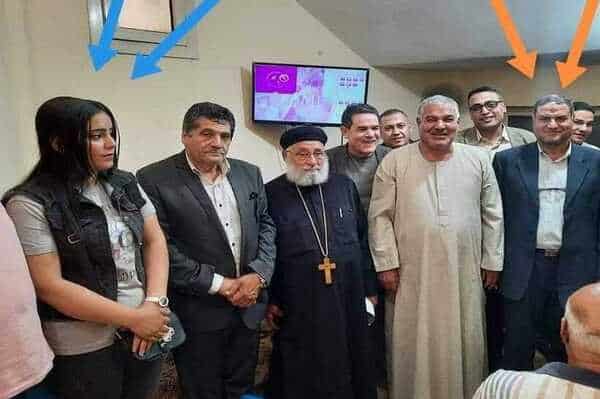
A photograph of the reconciliation session that went viral on social media shows Mrs. Sobhy standing among a group of men from her family and her village, alongside the perpetrator and a priest from the local church.
“It was a typical shameful reconciliation,” says Kamal Sedra, a human rights activist. “This is what usually happens in sectarian attacks in Egypt. Women do not have the right to say no. She is a woman in a society that undervalues women, while Copts are second-class citizens. It was expected for her to be forced into such a customary session.”
Sedra believes that the victim had no power to refuse reconciliation. “Even those Christians who are forcibly displaced from their homes do not have the ability to refuse reconciliation. The Coptic Christians are helpless,” Sedra says, citing the case of Mrs. Souad Thabet, the 75-year-old Coptic Christian woman who, in May 2016, was dragged naked down the street by a Muslim mob in her village, after false rumors began to spread of an affair between her married son and a married Muslim woman. “Mrs. Thabet left the village and cannot return or demand any of her property,” Sedra adds.
“The law in Egypt is not the rule, things depend on the mood of the authorities and political will. In the end, there are political calculations and a desire not to anger the Islamists because they represent an important voting bloc,” Sedra tells ACN, adding: “In general, in Arab and Islamic countries, there is a conflict between the international covenants signed by those countries and societal pressure driven by Islamic law. In Egypt, while the constitution stipulates that all people are equal, there is an article that states that Islamic Sharia law is the main source of legislation.”
Assaults on women and girls who don’t wear the hijab are frequent in Egypt, especially during the month of Ramadan, when Islamic hardliners consider it mandatory.
—Engy Magdy