Throughout Europe and the Americas, churches have been vandalized in the past three months. Although the attacks seem unrelated, they show that religious freedom is not to be taken for granted.
Vandalism at the popular European shrine of Medjugorje in Bosnia is the latest in a wave of attacks against churches in Europe and the Americas, involving acts of vandalism, desecration, arson, or theft. The number of incidents over the past three months raises concerns over a growing pattern of attacks against Christian places of worship.
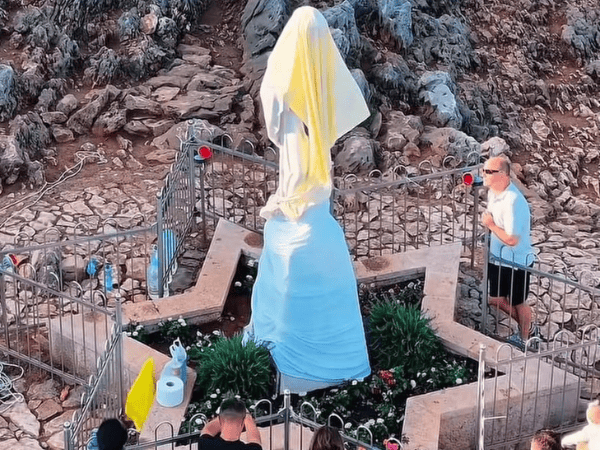
The incident at Medjugorje on Tuesday, July 28. involved desecration of a statue of the Virgin Mary and damage caused by fire. Local authorities are investigating the incident.
While the circumstances and motivations behind each case vary, all have one element in common: churches and Christian religious symbols have been deliberately targeted. The succession of incidents has alarmed local communities and renewed concerns about growing hostility towards places of worship, even in countries where Christians make up the majority of the population.
According to information gathered by Aid to the Church in Need (ACN) from local news reports, incidents occurred in Spain, France, Italy, Germany, Northern Ireland, Belgium, Colombia, Nicaragua, Poland, Mexico, the Dominican Republic, and the USA.
- In Colombia, on Sunday, June 21, an unknown armed group used drones to fire explosives against a church in the north of the country. A ten-year-old boy was killed in the attack, which also left five people wounded. Northern Colombia is one of the most badly affected by internal violence, but the reason for the attack is not known.
- Also in Colombia, on May 6, a man caused severe damage to the La Ermita chapel in Cali, breaking statues and destroying valuable works of sacred art. The 27-year-old was swiftly arrested, and authorities believe he was suffering from a psychotic fit, but the local population was left in shock and distress by the damage caused by his outburst.
- In Nicaragua, a country where the Church has suffered from severe persecution at the state level in recent years, a church was broken into twice in the Diocese of Estelí, on June 13 and 16. Thieves took musical instruments and furniture, but also destroyed an image of Jesus in the Franciso de Asis parish. Father Muñoz said that the incident showed a loss of values and of respect for the sacred. The priest added that those responsible for the crime were unaware of the sacredness of the house of God, and noted that they had also stolen a gas cylinder.
- A disturbing incident took place in southwest France, where individuals broke into a Church in Mugron and stole the Blessed Sacrament from the tabernacle. The break-in took place between June 14 and 17, and is being investigated by the authorities. A similar crime occurred between July 5 and 6 in the Church of St. Peter and St. Paul in Lille, where liturgical items and the tabernacle with consecrated hosts were stolen. On July 5, a man was arrested for entering the Church of St. Etienne in Mulhouse, and vandalizing the altar cross, several pews, and confessionals. The man was later arrested and considered psychiatrically unfit by the authorities. These were the latest in a long string of incidents involving churches in France, where arson attacks on churches have become relatively frequent. On June 12, just days before the desecration in Mugron, two churches were partially destroyed in fires, in Brittany and Gers; and a few days later, on June 24, an altar cloth was set on fire in a church in Val d’Oust. Similar arson attacks were registered as having taken place in Belgium on June 8; in Italy on June 16; in Northern Ireland on June 28; and in Germany on June 29. Earlier in Germany, on June 22, a man was arrested for causing severe damage to a church organ and to religious art in a church in Friesoythe.
- The Diocese of Saltillo in Mexico also saw a case of theft of the Blessed Sacrament from the tabernacle on June 12, although in this case, it appears that the criminals were after the vessels, rather than the Eucharist itself, as they abandoned the consecrated Hosts nearby. The local bishop called for prayer and ordered an act of reparation before the Church could be used again.
- More recently, on July 12, criminals broke into three different churches in the Diocese of Santo Domingo, in the Dominican Republic, and forced open the tabernacle to steal sacred vessels, leaving the Eucharist spread over the floor and on the altar.
- Acts of vandalism also took place in Spain. In Catalonia, a group of youths broke into the Church of Our Lady of Peace, in Òdena, on May 19, causing serious material damage to the interior, desecrating the altar and a Bible, stealing metal objects, including instruments, and covering the walls with graffiti. The act angered local residents, who were further distressed when the authorities opted to seal the Church to avoid more problems, rather than increase security.
- On June 8, a young man was arrested after vandalizing and desecrating the Church of the Assumption in Łubów, Poland. Apparently drunk, the man urinated on the floor of the church and damaged several religious objects.
- On the same day, in Oakland, California, unknown assailants damaged the Church of St. Columba, breaking crosses and other religious images, and even damaging a fountain that had been erected in memory of six Irish exchange students who died in an accident in 2015. The US Conference of Catholic Bishops keeps a list of such incidents, which is periodically updated.
The wave of attacks confirms the warning made by religious freedom expert José Luis Bazán, one of the authors of ACN’s Religious Freedom in the World Report: that religious freedom and the right to freedom of worship are not given factors even in majority Christian countries.
Although these incidents differ in nature and severity, their frequency within such a short period raises concerns about the protection of places of worship and respect for religious belief.
They also serve as a reminder that threats to religious freedom can also manifest themselves through repeated attacks on religious communities and their sacred spaces in Western countries.
Addressing the Spanish Parliament on June 8, Pope Leo XIV stressed that “freedom of thought, conscience, and religion” is “a decisive issue for every truly democratic society.” He also noted that an authentic state “recognizes the religious dimension of the person” and therefore “not only respects it, but protects it as well.”
The recent attacks on churches across Europe and the Americas serve as a reminder that safeguarding religious freedom involves not only protecting the right to believe, but also ensuring that places of worship are respected and protected.
– Filipe d’Avillez and María Lozano