Over a decade ago, Archbishop Sebastian Shaw tried to start a dialogue between Christian and Muslim leaders but was met by scepticism and little interest. But after years of building trust, the archbishop reports, Muslim leaders are now taking the initiative and are speaking up for persecuted Christians.
The archbishop of Lahore believes that pressure from Islamic scholars is key to getting the government to crack down on extremists who persecute Christians in Pakistan.
On a recent visit to Aid to the Church in Need (ACN)’s international headquarters in Germany, the archbishop described the fruits of interreligious dialogue in Pakistan, and how a recent manifestation of Christian persecution appears to be a turning point in relations between the Catholic Church and Islam.
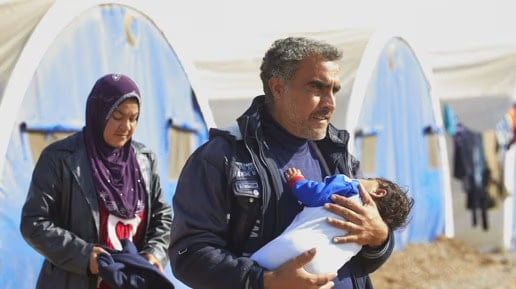
Thousands of Christians were forced to flee their homes as a Muslim mob attacked in Jaranwala, Pakistan on August 16th, in response to rumors that two Christian brothers had desecrated the Quran. Dozens of churches were torched, and hundreds of families were left homeless as their houses were looted and burned. Fortunately, nobody was killed, but Christians had to sleep in the fields for several nights, as it was too dangerous to return home.
“The next day, we had a press conference in Lahore, with six or seven Islamic leaders, or ulemas, who are members of our dialogue group. I showed one of them pictures of children sleeping in the fields and said, We are only two percent of the population. You are 97 percent. Why are your people doing this to us?’ He was very upset, and during the press conference, he became emotional. He turned to me and said, ‘Bishop, I ask pardon, on behalf of all our people.’”

Muslim voices against radical Islam
Archbishop Shaw stresses that Pakistan was originally envisioned as a model of religious freedom, allowing non-Hindus to escape the strict caste system of India at the time. Christians in the region where Jaranwala is located were instrumental in ensuring that western Punjab joined the newly formed country.
However, the rise of radical Islam has been a problem for decades, and the government lacks the will to crack down on extremists, as this could trigger unrest across the country. The archbishop explains, “Pakistan is tolerating this evil, but the problem is that this evil then becomes so big that it is difficult to control. Many people were arrested after the riots, mostly members of the extremist TLP party. But the government is reluctant to punish them, as there could be repercussions in other cities. Traditionally, what they do is force reconciliation between Christians and the aggressors, so that we forgive them, and that might be what they will propose this time as well.”
But Archbishop Shaw believes that things are changing. “The voices of Muslim scholars have become very important, especially where the government and the armed forces find it difficult to intervene. One of the results of our dialogue is that, for the first time, many Muslim scholars stood with us, and they are still supporting us. For example, I met with the national leader of one influential Muslim group, Jamaat-e-Islami, in Jaranwala, and he told me that he was very sorry for what had happened. He promised that they would support the children who lost their schoolbooks when their houses were burned. Two weeks ago, they donated books to 200 children. This is a result of our dialogue, and this is why we need to promote dialogue more.”
The archbishop has been heavily involved in interreligious dialogue for many years. He used to be the chairman of the interfaith dialogue commission for the Pakistani Bishops’ Conference, and he continues to work with dozens of Islamic dialogue partners in his own archdiocese. He is also a member of the Vatican’s Dicastery for Interreligious Dialogue.
Breaking down barriers
Initially, he says, Muslims found the concept of interreligious dialogue difficult to grasp. “At first, many Muslims rejected dialogue, saying that Islam is very clear: you are either Muslim or you are not—there is nothing to discuss. But after several years of effort, some of them have now come to understand what we are doing, and what we can achieve together. For example, we studied the Pope’s document on the environment, Laudato Si’, together. Now, when they see incidents like what occurred in Jaranwala, many Muslims feel that this cannot be the image of Pakistan.”
The archbishop hopes that the voices of prominent Muslim leaders denouncing the persecution of minorities in Pakistan might encourage the government to protect Christians and other faith groups and to punish those who attack them. More importantly, he says that the ulemas are taking the initiative themselves. “Just last week, we had a meeting at our bishops’ house, during which two ulemas, including the grand imam of Lahore, agreed to organize a national interfaith conference in the federal capital of Islamabad. In this way, they are influencing the government to work more for dialogue and for a better society in Pakistan,” he concluded.
ACN has supported interreligious dialogue in Pakistan for many years, including the co-financing of Christian-Muslim dialogue at the Peace Center in Lahore and other activities for young people, teaching them to work toward peace, solidarity, and communication.