
Since the escalation of the conflict in the Middle East at the end of February 2026, the southern border of Lebanon has again become a war zone. In this context of increased violence, Fr. Maroun Youssef Ghafari, the Maronite parish priest of Alma Sha’b, on the border with Israel, has decided to stay with his community despite the danger. His determination has already been put to the test in a dramatic way, when his brother Sami Ghafari, 70, was killed in the garden of his house, in the same village, by an airstrike.
Amid the mostly Muslim landscape of southern Lebanon, there are Christian majority villages such as Qlayaa, Marjayoun, and Alma Sha’b. Despite the recent intensification of fighting between Israel and Lebanon-based Hezbollah, a militant group backed by Iran, and Israeli evacuation orders, many inhabitants have chosen to remain on their land. Christian residents fear that their property and fields might be destroyed if they leave.
It was in the Christian village of Qlayaa March 9, in the district of Marjayoun, that an Israeli airstrike mortally wounded Maronite Fr. Pierre al-Raï. Four civilians were also wounded. Casualties include residents and members of the rescue teams that had come to help following an initial blast.
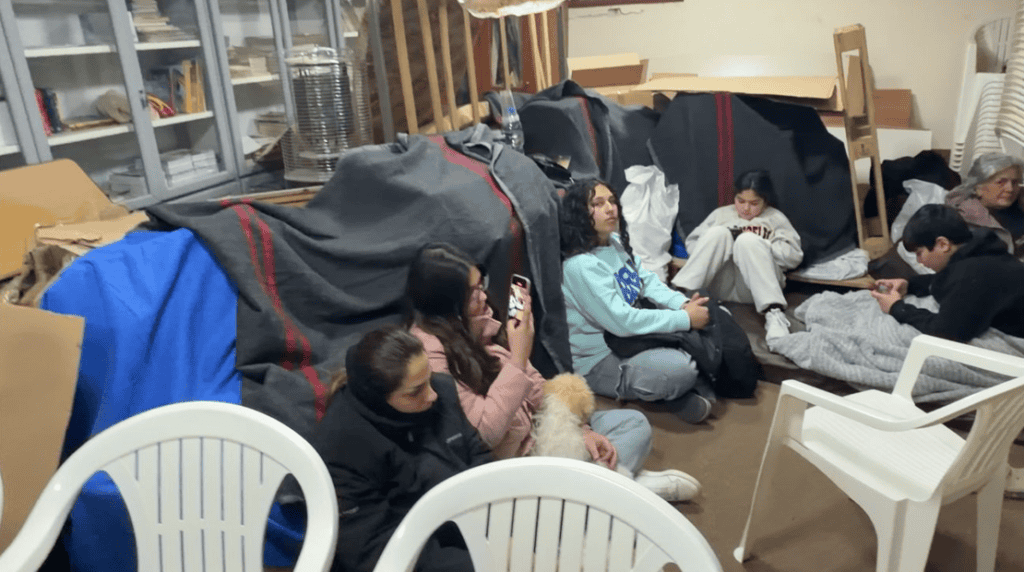
Alma Sha’b is located just about a mile from the Israeli border. Before the fighting resumed, there were almost 350 inhabitants in the village. Currently, the number has dropped to 100, between adults, children, and elderly.
Maronite Chorbishop Maroun Youssef Ghafari, parish priest of Alma Sha’b, told pontifical foundation Aid to the Church in Need (ACN) that the Church supports residents in their decision to stay.
“We will remain despite the war,” Fr. Ghafari said. He added that the community has paid a high price because of the conflict. “Around 90% of the houses were destroyed when we were forced to leave in late December 2024. We believe that if we go again, for any reason, we will not be allowed to return and that whatever is left behind will be destroyed once more.”
“Since February 28, 2026 [the beginning of US-Israeli military operations against Iran], we have been going through difficult times, because there have been strikes on the village and surroundings which have damaged some houses, although there are no casualties to report so far,” Fr. Ghafari said.
The priest told ACN that residents of other Christian villages near the border have made the same decision to stay. “We have taken the appropriate measures with the Apostolic Nuncio, the local Church, and civil authorities, and with the United Nations Interim Forces in Lebanon (UNIFIL), informing them that we are not going to be leaving, even though we know that in a time of war, there are no guarantees,” the chorbishop said.
His own brother, Sami Ghafari, 70, was killed on March 8 when he was in the garden of his house in Alma Sha’b. The death, as a result of hostilities, had a deep impact on the priest and the local Christian community. A delegation from ACN visited the village during the ceasefire, before the current conflict began, and took part in Mass there with the local community. Sami Ghafari was among those present.
The priest expressed his sorrow to ACN, saying “to lose a Lebanese citizen who loved his village of Alma Sha’b and who was totally unrelated to the conflict and who, what is more, was my brother, has left us in the deepest sadness. War causes nothing but destruction, death, and displacement.”
Fr. Ghafari added that “as a priest and as a Christian, I consider Sami a martyr. They killed him. Yesterday, Fr. Pierre al-Raï, the Maronite priest of Qlayaa, was also killed while serving in his parish. We pray that their souls may rest in peace and that their memory be a source of consolation and strength for our communities.”
Act of Faith
For Fr. Ghafari, the decision to stay is an act of faith. “We trust in divine providence and in the intercession of the Virgin Mary, our protector,” he explained, recalling that Christians “have nothing to do with this war” and remain devoted to a culture of life, dialogue, and peace. “We pray for this intention in all our daily masses, and every Sunday.”
The Christians of Lebanon are living proof that Middle Eastern Christianity is not only a demographic reality, but a living presence, embodied by men and women who bear witness to their attachment to their faith and to their land. In this sense, the parish priest of Alma Sha’b highlighted the importance of prayer and practical support. “If the universal Church does not care for these communities spread out near the border – which have been reduced to no more than 15 damaged Christian villages – they risk suffering the same fate as the Christians of the Holy Land,” he warns. “We hope they do not disappear over time. Through their attachment to their sacred land, they offer the most beautiful witness of faithfulness and perseverance.”
Fr. Ghafari believes that the priority at the moment is ensuring safety and restoring peace, and thanks ACN for its support. “In the name of the parish, and especially of the poor –those closest to Jesus – I wish to express our heartfelt gratitude to all who support us, especially to ACN, which has been by our side through the provision of material aid, food, and medical supplies.”
“We remain united in prayer, with the Catholic Church, Christians from all over the world, and all people with common sense, for an end to this disaster,” he added.
According to the latest information received after this article was written, the village of Alma Sha’b is expected to be evacuated due to the deteriorating security situation in the area.
– Christophe Lafontaine


