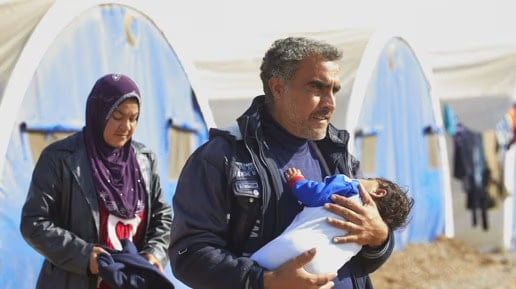
Iraq is no longer plagued by a jihadist group, but for Christians, evangelization is almost out of the question.
Iraq is not the country it was in 2014, when the Islamic State group threatened Christians and other minorities as it sought to establish a caliphate.
Archbishop Bashar Matti Warda, the Chaldean archbishop of Erbil in northern Iraq, said in an interview that his country is much more stable than it was a dozen years ago and that Christians are free to practice their faith without fear.
But, he said, there is a long road to travel before Christians are truly on an equal footing with the rest of Iraqi society.

Archbishop Warda, who welcomed thousands of Christians to his diocese as they fled from Mosul and the Nineveh Plain in 2014, spoke with Dr. Robert Royal, special advisor to the board of Aid to the Church in Need-USA on the matter of Christian persecution, in the latest edition of the “Faith Under Siege” podcast (full broadcast below).
The archbishop said that many areas of the country enjoy greater security, and that nine villages that had been occupied by ISIS were now fully rebuilt, allowing 10,000 Christian families to return home.
But Iraq’s economy is still “uncertain” and the nation is still plagued by corruption, he complained.
“Final stability is not there,” Archbishop Warda told Royal, president of the Faith & Reason Institute in Washington, D.C. “Many young people struggle to find jobs.”
That is a major factor in the perennial struggle to maintain a Christian presence in Iraq.
Although churches can celebrate liturgies and carry out many pastoral practices freely, Christians are not equal citizens under the law, the archbishop maintains.
According to ACN’s Religious Freedom in the World Report, under Iraq’s 2005 constitution, Islam is the official state religion and a “source of legislation.” Nothing may contradict Islam, the principles of democracy, or constitutionally recognized rights and freedoms. The governing document provides that the Islamic identity of most Iraqis and the religious rights of Christians, Yazidis, and Sabean-Mandeans are equally protected.
Still, the archbishop said, “being a minority you really need to struggle to get your rights. Everyone feels that we don’t have full rights as citizens.” Christians wonder, “Who’s going to protect us, to maintain our rights of citizenship?”
He said that the attitude of non-Muslims not being considered full citizens is “the reality we’ve been living over the past 14 centuries.” Therefore, Christians come to regard the Church as “the most powerful voice to advocate for their rights.”
Spreading the Gospel
One particular problem Christians face in Iraq is in sharing their faith. The archbishop said that it’s “dangerous” for Muslims to convert to Christianity.
“The only thing we can do for inquirers is to inform them,” he said, adding that the Church does get a good number of inquiries from Muslims. “Our Lady is quite a figure: she is adored by Muslims. When you visit our churches in Iraq, you see Muslims praying to Our Lady. Sometimes a whole family comes to inquire, and people will say, ‘I’ve seen Jesus in my dreams; I’ve seen our Lady in my dreams. Please explain what this means, what that means.’ … Whenever we tell them ‘This will put you in danger; we cannot really continue,’ they challenge me, ‘Who are you to prevent me from [believing in] Christ?’”
“At the end of the day, I would say, ‘I did not go and preach to them. They came, and it’s my responsibility to share with them the concern and faith that they have.’”
One answer to the dilemma is to strive to maintain the Church’s longstanding reputation as a reliable provider of education, healthcare and other services, he said. “We were always leaders in education, in healthcare. … Through those social services that we give with love and compassion and mercy and quality, we can make an impact.”
Archbishop Warda has established the Catholic University in Erbil, Mar Qardakh International School, and Maryamana Hospital. ACN has been a major supporter of the university and continues to provide scholarships for students attending the institution.
“Today we have more than 70 Muslim students,” the archbishop reported. “Families trust us. We are serious about trying to provide a quality education.”
The archbishop acknowledged ACN’s help in rebuilding homes post-ISIS and in establishing the Catholic University in Erbil. But he suggested that the “biggest contribution” the papal foundation has made to Iraq is a matter of information.
Said the archbishop, “ACN helped people to not forget the persecuted Christians, not just in Iraq but around the world.”
–John Burger
Below is the full broadcast of Robert Royal’s interview with Archbishop Warda. Previous episodes of “Faith Under Siege” can be found here.