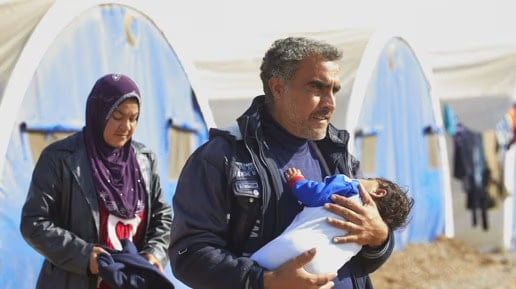
Denis Alaniz keeps a close eye on his homeland as he enjoys freedom and democracy in “home away from home.”
As America celebrates its 250th birthday, the “inalienable rights” of life, liberty, and pursuit of happiness acknowledged by the Declaration of Independence continue to inspire millions of would-be immigrants and refugees.
Those rights — including religious liberty — are still denied to significant numbers of people living under oppressive regimes.
Denis Alaniz is one of those refugees who has come to these shores seeking religious freedom.
Hailing from the north of Nicaragua, Alaniz, 41, now lives in Indianapolis, where he is an active member of a Catholic parish. He prays not only that he will continue to enjoy religious liberty here (or perhaps one day back home), but also that those he left behind in Nicaragua will as well.
Growing up in a devout Catholic family, Alaniz naturally veered toward service in the Church — first as a catechist and later as a communications expert in the Diocese of Jinotega.
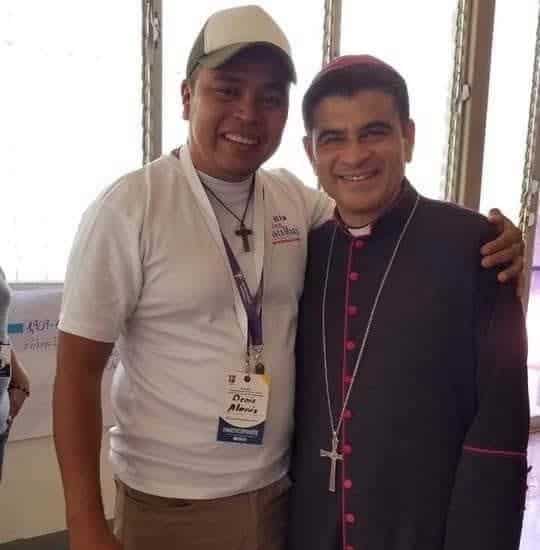
“I began to work in some local media promoting evangelization,” he recalled in an interview with ACNUSA.
In 2016, he said, there were indications of a coming persecution of the Church in Nicaragua. Alaniz’ own brother Danilo, a minister of communion, was “brutally beaten by the Nicaraguan police when he was taking Viaticum to some sick people,” Denis Alaniz said.
In 2018, in the wake of a violent suppression of protests against the Ortega regime, the Church opened its doors to the wounded. Alaniz was working in Church media, which was speaking out in favor of human rights and fundamental freedoms. A local government official advised him to keep a low profile.
Within two years, though, the police arrested him.
“I was detained for four days, but thanks to the intervention of the Church I managed to get out,” he said. “We decided to focus more on evangelization and not so much on human rights.
That was not the end of his troubles, though. Following some crime reporting he did for secular media, he was threatened again with arrest. But this time, he was given the option to leave the country voluntarily.
While crossing into Honduras, he decided to try to make his way to the United States.
Finding a blessing
Meanwhile, government authorities were arresting or expelling bishops and even Alaniz’ own pastor.
ACN’s Religious Freedom in the World Report 2025 lists Nicaragua as one of 24 countries where religious persecution is a major problem. In this case, the persecution is attributed to an authoritarian government.
Constitutional amendments of 2025 defined Nicaragua as a revolutionary socialist state and limited any speech or religious practices that “violate public order” and constitutional principles. It stipulated that religious organizations must be free from any form of foreign control.
In February 2023, the UN Human Rights Council published a report on the human rights situation in Nicaragua, denouncing arbitrary detentions and unjust convictions. One such case was that of Bishop Rolando Álvarez of Matagalpa, who was arrested in 2022 after police entered his chancery by force. In February 2023, he refused to board a plane taking 222 other individuals into exile and was sentenced to 26 years in prison. He and another bishop were released in 2024 and expelled from the country, along with 15 priests and two seminarians who had been missing and held as political prisoners.
In November 2024, the President of the Bishops’ Conference, Carlos Enrique Herrera Gutiérrez, O.F.M., Alaniz’ own bishop, was also expelled. He is still living in Guatemala.
From his perch in Indianapolis, Alaniz has taken his background in media to launch Panorama Católico. There, he chronicles the ongoing persecution in his homeland.
“One of the things that sometimes does not appear in the media is the persecution that the regime has implemented against catechists, Catholic Action and Catholic families who resist obeying when they are asked to be spies in the parish,” Alaniz said. “The government wanted to force an altar boy in a parish in northern Nicaragua to spy on the parish priest. He refused, and they issued an arrest warrant, but this boy managed to flee to Costa Rica and eventually to Guatemala. I also documented the case of a young woman from youth ministry in the diocese of the Northern Caribbean who was going to be forced to report the identities of young people who came to the youth ministry. She refused and had to go into exile in Costa Rica.”
Alaniz is grateful to have refuge in the United States, a land that he said represented freedom and democracy, though he is not breathing easy yet, due to uncertainty about his legal status and his pending claim for asylum.
In spite of his ordeal, or perhaps because of it, he finds blessings in the midst of it all.
“For me as a Catholic Christian, it has been a hard experience, but also wonderful, carrying the cross of Christ,” he said. “I never thought I would have to testify, have to witness the faith from a place of exile, in persecution and knowing that my priests and bishops are persecuted, just like Christ. For me it has been like a spiritual retreat. The persecution that we Catholics suffer in Nicaragua will increase the faith, will increase the church. We have been able to testify, we have been able to stand firm, and the Church continues to be the only light.”
–John Burger