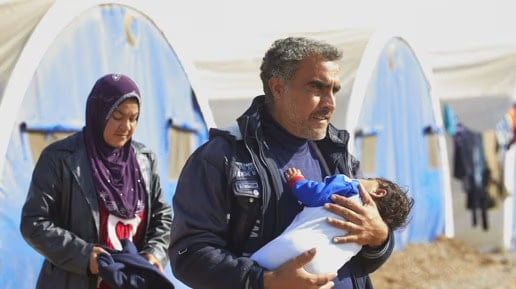
The Secretary of State also called attention to the multiple conflicts that continue to rage all over the world.
The Secretary of State of the Holy See, Cardinal Pietro Parolin, strongly denounced the persecution that Christians are subjected to in many parts of the world, in a speech made on Saturday, September 26, 2026.
Speaking at the General Assembly of the United Nations in New York, Cardinal Parolin said that “tragically, Christians in many parts of the world continue to suffer discrimination, violence, and outright persecution simply because of their faith. Churches are attacked, communities displaced, and individuals killed or imprisoned.”
“While condemning all forms of religious discrimination, the Holy See raises its voice on behalf of these brothers and sisters, not in a spirit of exclusive advocacy, but because the defense of any one community’s freedom strengthens the freedom of all. Silence in the face of such suffering would be a betrayal of the Church’s mission and of the universal human rights the international community has pledged to uphold,” the Cardinal said.
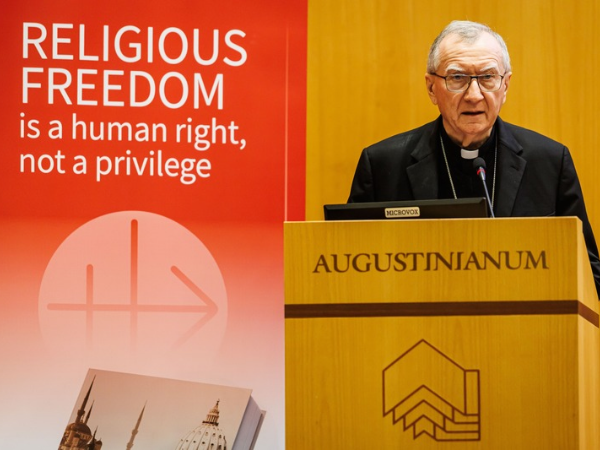
Religious Freedom is a central tenet for pontifical charity Aid to the Church in Need (ACN). Besides publishing the Religious Freedom in the World Report (RFR), the foundation has also launched a petition calling on respect for religious freedom as a fundamental right, and not a privilege.
According to the 2025 edition of the RFR, more than 5.4 billion people — almost two-thirds of humanity — live in countries where religious freedom is not fully guaranteed. The report identifies serious violations in 62 countries: 24 classified as persecution and 38 as discrimination.
ACN estimates that around 220 million Christians live in regions where they are in immediate danger of suffering persecution, although not all Christians in a given country face the same levels of hardship.
In a nod to the plight of many refugees, migrants and asylum seekers, the Secretary of State insisted that the dignity of each person “is not dependent on geographical location or socioeconomic status.”
“Those who move, or are forced to move, always maintain their dignity. It is essential to continue to address the underlying causes so that migrating once again becomes a matter of choice rather than one of necessity forced by circumstance. It is important not to ignore the plight of those seeking refuge, those forcibly displaced from their homeland, and those undertaking perilous journeys.”
Wars and humanitarian crises
The situation in the Holy Land, and in the Middle East more generally, was the center of much attention and debate at the 81st Session of the General Assembly of the UN. Cardinal Parolin did not neglect to mention this, but also called attention to other conflicts around the world.
“The Holy See reiterates its call for an end to the ongoing violence against the Palestinian civilian population in the West Bank, particularly the escalation of hostilities, home demolition and movement restriction, driving the displacement of Palestinian communities.”
Among these communities, according to ACN project partners on the ground, Christians are disproportionately affected.
Speaking about the situation in the Democratic Republic of the Congo, Cardinal Parolin said that “the Holy See is preoccupied by the terrorist attacks, especially in North Kivu and Ituri, which repeatedly target the civilian population, including Christian communities, involving killings, abductions, and the destruction of villages and Church structures.”
The speech also referred specifically to Sudan, South Sudan, Somalia, and the Sahel region, as well as the plight of the Rohingya and the violence plaguing the province of Cabo Delgado in Mozambique, an issue ACN has covered extensively for years.
The Latin American countries of Venezuela, Haiti, Cuba, and Nicaragua are also in the mind of the Holy See, said the Secretary of State, as is the peace process currently underway between Armenia and Azerbaijan.
The Holy See is not a fully-fledged member of the United Nations, but instead holds the status of Permanent Observer State, entitling it to participate in debates and assemblies, make motions, and sit in the General Assembly, but not to vote or sponsor resolutions.
– Paulo Aido