Tobias Yahaya almost lost his life during an attack on his home in Nigeria. Fortunately for him, his wife, and their four small children, Yahaya, who was stabbed in the chest, was saved by doctors in hospital.
But Yahaya, a Catholic catechist, gained something more. And perhaps the wider community – his parish in Sokoto City and the predominantly Muslim population of Sokoto State in northwest Nigeria – gained a valuable example.
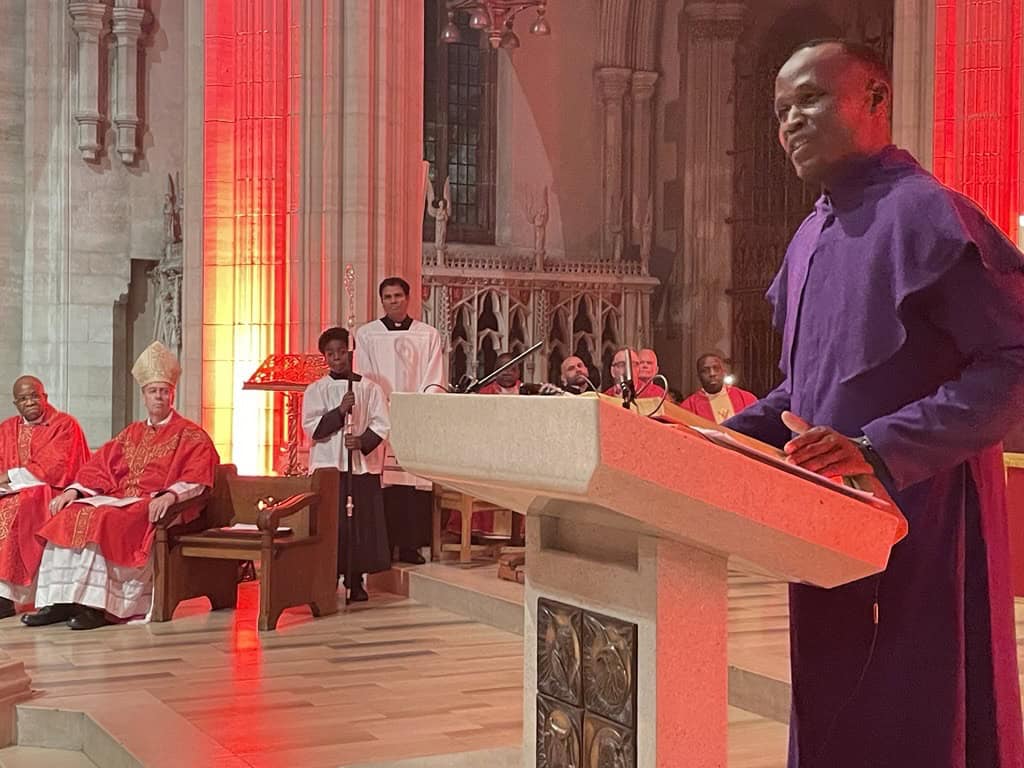
Around 3 A.M. on April 19, 2023, the security fence around Yahaya’s home near Sokoto’s Holy Family Cathedral, where he works, was breached by three armed men. Yahaya was awakened by the intrusion. He wondered whether it would be better to hide inside or go out to confront the intruders.
“As a father, you think of many things at that moment, because if they eventually happen to come inside and meet me with my children, only God knows what will happen,” he said in an interview with ACN-USA. “So I decided to go outside.”
The leader of the small group, whose name Yahaya would learn to be Ibrahim, took out a knife and stabbed the catechist in his chest.
“I fell to the ground bleeding,” Yahaya, 26, recalled. “And the two others fled, maybe thinking that the mission has been accomplished.”
Ibrahim remained, standing over Yahaya. He attempted to stab him again when he tried to get up.
“But this time around I held the knife in my hands,” Yahaya said. “So when I held it, he screwed it in my hands, which gave me serious injuries in my palms. I had to let the knife go. I managed to hold him close to my body so I wouldn’t give him the chance to use the knife on me again.”
Little did Yahaya know that this was not the last encounter with his attacker.
Unexpected encounter in hospital
Yahaya’s wife began screaming, alerting neighbors, which ultimately led to Ibrahim’s apprehension. Yahaya lost so much blood that he became unconscious. When he woke up about 24 hours later, he found himself lying in a hospital bed – next to Ibrahim, who was also being treated for his injuries.
“I turned and asked him, ‘Ibrahim, why do you want to kill me?’” Yahaya related. “Ibrahim couldn’t talk to me. He was in tears. I asked him again. The people around me were like, ‘Why are you talking to this person? Concentrate on your health.’ I said, ‘I want to know the reason why he intended to take my life.’”
Later, during Ibrahim’s criminal trial, it came out that he and his two companions, who have not yet been apprehended, feared the catechist’s influence on the young people of the area, which is 90% Muslim. It was not the first time Yahaya, who often wears a cassock to identify himself as a catechist, was challenged for his Christian ministry.
Yahaya explained that in Nigeria, the ministry of catechist is much more than simply volunteering an hour or two a week to teach Sunday school. Catechists serve at the altar, arrange for baptisms, and conduct services in places where a priest cannot be, for one reason or another. Yahaya might go to a town where there is a priest, for example, bring back consecrated Hosts, and conduct a Communion service on Sunday morning.
His work is contributing to the growth of the Church in Sokoto. “Last Easter we confirmed 100 children in our parish,” he said.
Teaching by example
But perhaps the greatest lesson his flock can learn from his ordeal is what happened during Ibrahim’s trial. As the judge was about to hand down a sentence of a year in prison, Yahaya spoke up.
“I asked the Muslim judge, ‘Can I hug Ibrahim?’” Yahaya said. “And there was this expression of disappointment, disbelief, surprise from everybody in the courtroom. The judge asked ‘You want to hug him?’ I said, ‘Yes, I want to hug him.’”
The judge said it was okay, and Yahaya went over to where Ibrahim was standing. “I hugged him and I shook his hand, and I told him that ‘I have forgiven you,’” the catechist recalled. “He wasn’t able to talk to me, but I saw tears running down his cheeks. I told him again, ‘I have forgiven you.’”
Ibrahim was led off to prison, and Yahaya and his family went home. They were filled with questions about what to do next.
“What does God want to communicate to us through these kinds of situations because that was not the first attack,” he said. “I still wish to continue my work as a catechist. My wife was supportive. My mother was supportive. There were prayers, counseling from my bishop and priests and other people.
“In the midst of all the counselling, my mother, who has no Western education — didn’t go to school — said something that sticks in my mind, and I’m going to die with this. She told me, ‘Where God intends us to be may not be as comfortable or to our taste, but that’s where we find true happiness.’ And I think she’s right.”
And so Yahaya continues, sustained by the words of St. Paul, in his Second Letter to the Corinthians, Chapter 4:
“We are afflicted in every way but not constrained; perplexed, but not driven to despair; persecuted, but not abandoned; struck down, but not destroyed; always carrying about in the body the dying of Jesus, so that the life of Jesus may also be manifested in our body. For we who live are constantly being given up to death for the sake of Jesus, so that the life of Jesus may be manifested in our mortal flesh. So death is at work in us, but life in you.”
–John Burger