U.S. Commission on International Religious Freedom details worrying trends in Nigeria, Middle East, Indian subcontinent, and even in the West.
The U.S. Commission on International Religious Freedom, the independent, nonpartisan panel that advises the U.S. government, is recommending the redesignation of 13 “Countries of Particular Concern and designating five additional countries be added to that list.
The nations now on the list of CPCs are Burma, China, Cuba, Eritrea, Iran, Nicaragua, Nigeria, North Korea, Pakistan, Russia, Saudi Arabia, Tajikistan, and Turkmenistan.
The five countries that USCIRF would like to see added to that list are Afghanistan, India, Libya, Syria, and Vietnam.
USCIRF made the recommendations in its latest annual report.
As defined by the International Religious Freedom Act (IRFA), the U.S. State Department designates countries as CPCs for “systematic, ongoing, and egregious violations of religious freedom.”
Nigeria has been the center of attention for religious freedom violations for several years. After previously being designated as a country of particular concern, and then removed from that list, Nigeria was again designated a CPC late last year – this time, by President Donald J. Trump.
USCIRF noted that in 2025, religious freedom conditions in Nigeria “remained abysmal.”
“Federal and state governments continued to tolerate, inadequately respond to or investigate, or otherwise fail to pursue justice for religious violence by nonstate actors,” the commission said. “These nonstate actors routinely seek to impose a singular interpretation of Islam on individuals and communities in their areas of operation, regardless of these individuals’ or communities’ own religion or belief.”
USCIRF named some of those “non-state actors,” who are among the groups that it recommends to be redesignated as “Entities of Particular Concern” in the coming year. They include Jama’tu Ahlis Sunna Lidda’awati wal-Jihad (JAS, also known as Boko Haram), Islamic State in West Africa Province (ISWAP), and Islamic State-Sahel Province (ISSP).
JAS last January burned down a church auditorium, killing several people.
The commission noted that Fulani militants continued to attack religious communities throughout the year.
“Increasing violence in the Middle Belt region especially impacted Christians,” USCIRF said. “Fulani gunmen killed around 200 displaced persons at a Catholic mission in Yelewata in June, after which some protesters accused the government of failing to protect the victims. Militants also killed Reverend Yahaya Kambasaya and abducted 20 other Christians in Kaduna in October, and attackers abducted 38 worshippers from a church service the following month, killing two and kidnapping the pastor. Assailants also abducted over 300 people, primarily schoolchildren, from a Catholic boarding school.”
Many of the incidents USCIRF presents in its annual report have been previously reported by the pontifical foundation Aid to the Church in Need.
While the Nigerian federal government came in for criticism for failing to decisively act to address or respond to the ongoing epidemic of religious violence, the military carried out a series of counterinsurgency operations throughout the year, killing 100 militants in Zamfara in August and 17 in Borno in September, while arresting 85 and rescuing 10 abductees in the process.
“The military also faced a significant shakeup in October when President Bola Ahmed Tinubu replaced its leadership to ‘strengthen the national security architecture’ after a reported coup d’etat plot,” USCIRF noted. In November, after Trump’s designation of Nigeria as a CPC, Tinubu “reaffirmed his commitment to defeating terrorism” as he redeployed 100,000 police officers from bodyguard duty to operations countering violent threats while ordering more forest guards to address the kidnapping epidemic.
In addition to the recommendation of redesignating Nigeria as a CPC, USCIRF recommended that the United States “enter into a binding agreement with the Nigerian government … to encourage substantial steps to address violations of freedom of religion or belief, including reporting on religious violence, returning displaced persons to their homes, and improving security and military training; and tie foreign assistance as well as bilateral policies on trade, arms purchases, and visa reciprocation to benchmarks on religious freedom improvement.”
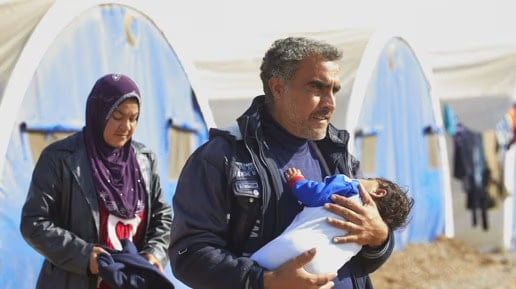
There were approximately 3.5 million internally displaced persons in Nigeria by the end of 2025, according to USCIRF, many of whom were victims of religious violence.
“The government has been slow and ineffective in rebuilding security and infrastructure necessary for them to return to their homes in a safe and dignified manner,” the commission said.
Syria
USCIRF also examined Syria, where the long-running Assad regime was overthrown by a coalition led by a former Islamist in late 2024.
“In 2025, religious freedom conditions in Syria dramatically deteriorated as the country’s religiously diverse population struggled to regroup after almost 14 years of civil war,” USCIRF said. “Even as the self-installed transitional authorities promised to reject the sectarianism of the regime they had overthrown, they demonstrated systematic and ongoing tolerance of particularly severe religious freedom violations throughout the year.”
Specifically, the commission said, transitional authorities failed to prevent, curb, or adequately administer justice for multiple mass killings, kidnappings, and other egregious acts of violence against Alawis, Druze, Christians, and other religious minorities — many of which occurred at the hands of purported loyalists to the new administration.
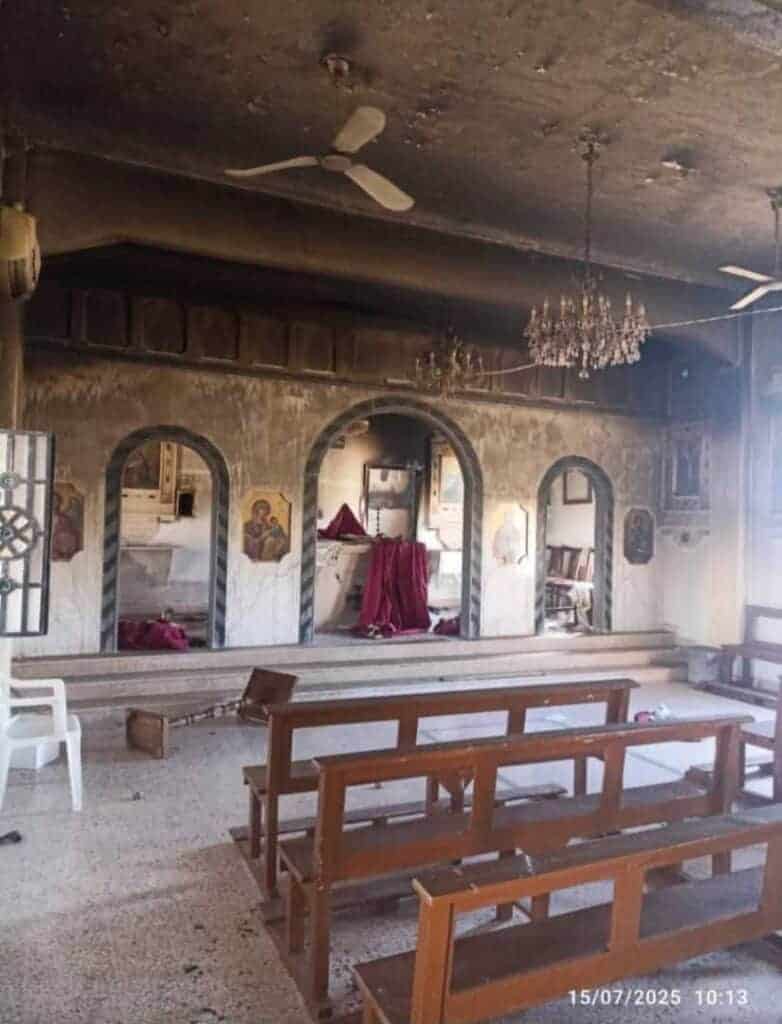
The commission noted the June 2025 bombing of the Mar Elias Antiochian/Greek Orthodox Church in Damascus that killed at least 25 Christians during a Sunday liturgy.
In addition, militant actors perpetrated hundreds of individual kidnappings, tortures, and murders of Alawi, Christian, and Druze community members, the panel said.
USCIRF pointed out that it had long recommended the transitional authorities’ predecessor organization — Hay’at Tahrir al-Sham (HTS) — as an Entity of Particular Concern (EPC) for its egregious violations of religious freedom. Now in power, HTS has purged Christians and others from government and other posts and appointed ministers and military and intelligence heads with records of violent religious freedom abuses.
In addition, large swaths of eastern Syria remained inhospitable to religious freedom, partly due to increasingly resurgent Islamic State of Iraq and Syria (ISIS) cells.
Iraq, India, Africa
In neighboring Iraq, religious freedom conditions remained “challenging,” USCIRF maintained. Of the country’s 47 million, less than one percent is believed to be Christian.
In India, USCIRF said, 12 out of 28 states maintain laws that forbid Hindus to convert to another faith, and several state governments strengthened or introduced laws to include harsher penalties and broader definitions of “religious conversion.”
In November, Indian officials reportedly denied a visa to the American evangelist Franklin Graham. In October, police arrested a U.S. citizen, James Watson, and two Indian nationals, Ganpati Sarpe and Manoj Govind Kolha, accused of converting Hindus to Christianity in Maharashtra.
Two African nations Pope Leo XIV will be visiting this spring also came under scrutiny in the new report. USCIRF recommends that Algeria be placed on a Special Watch List, saying religious freedom conditions “remained poor and unchanged from the prior year.”
“The government continued its systematic campaign against minority religious communities, enforcing the anti-blasphemy provisions in Article 144 of the Penal Code and the proselytization ban under Ordinance 06-03, which penalizes anyone who ‘incites, constrains or utilizes means of seduction intending to convert a Muslim,’” USCIRF said religious gatherings for non-Muslims in Algeria must have state permission.
And in the Far North region of Cameroon, Jama’tu Ahlis Sunna Lidda’awati wal-Jihad (JAS)/Boko Haram reportedly abducted Fr. Valentin Mbaïbarem of the Garoua Archdiocese, later releasing him.
The report said that Christians across central Africa have become increasingly vulnerable to targeted attacks by nonstate actors. “State Department-designated EPCs such as Jama’at Nusrat al-Islam wal Muslimin (JNIM), Islamic State-Sahel Province (ISSP), and Islamic State in West Africa Province (ISWAP) regularly commit violence against Muslims who reject their ideology, but they typically reserve their most consistent, targeted attacks for Christian communities across the region,” said the commission. “This alarming and rising trend is evident, for example, in Benin, Burkina Faso, Cameroon, Mauritania, and Mozambique, where nonstate actors regularly destroy churches, abduct Christian schoolchildren, seek out Christian converts for execution, and carry out other horrific forms of religious violence. Those intolerable conditions forced many Christians and others to hide or curtail their religious activities, or in many cases to seek safe harbor elsewhere as internally displaced persons or refugees.”
In the West too
The report said that attacks on houses of worship continued to spread across Europe, ranging from acts of vandalism to severe desecrations and prompting an array of security and legal responses. “There were arson attacks on houses of worship, including churches in Italy, Germany, France, Spain, Grenada and the UK,” said the document. “Assailants also attacked houses of worship with human waste. Their targets included churches in Germany, Italy, and the Vatican.”
–John Burger