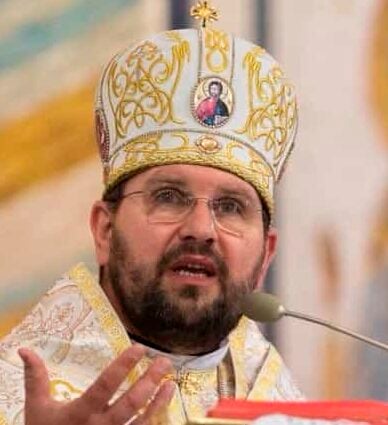
Maksym Ryabukha is a war-zone bishop. Half of the diocese he leads — the Exarchate of Donetsk, Ukraine — is occupied by the Russian army, making it impossible for him to carry out his ministry.
But Ryabukha, who is an Archepiscopal Exarch in the Ukrainian Greek Catholic Church, insisted that he continues to see “constant signs of hope,” even amid the destruction caused by the ongoing war. The 46-year-old Salesian prelate pointed to the fidelity of his priests serving on the front line, for example, as well as to the solidarity witnessed among the youth and the strength of the prayers of mothers. He spoke with pontifical charity Aid to the Church in Need (ACN) recently during a visit to its headquarters in Germany.
One year ago, you told ACN that half of your exarchate was under Russian occupation. What is the situation at the moment?
The front line is constantly moving. We recover some territory, but other times, it is the Russian forces who advance. Beyond the lines on the map, though, it is the war itself that has changed. One year ago, if you were around 20 kilometers [12 miles] from the front line, you were pretty much safe. Today, given the massive use of drones and guided bombs, anywhere under 50 kilometers [31 miles] is extremely dangerous.
What is it like for the churches in the occupied territories?
Unfortunately, the material destruction is devastating. Now, they are razing houses, one by one, including rectories. In Kostantynivka, the church was destroyed. Through images taken by drones, we can see that only a fragment of the cross on the central dome is still intact. There is hardly a stone in place. It is very harsh.
How do you exercise your ministry as a bishop at the front?
I do so by being a bishop of prayer and accompaniment. I cannot stop the war, nor change the course of military history, but I can be close to people: in prayer, in dialogue, and through my pastoral presence. Despite the tragedy, I can see clearly that God does not abandon us. There are constant signs of hope.
What do you mean?
Not long ago, during a course for priests, the preacher told me: “I am struck by the fact that your priests are so happy and serene.” Humanly speaking, this seems impossible. Where does this serenity come from? It comes from prayer and priestly brotherhood. We try to meet together as often as possible. With this accompaniment, I can be sure that, come what may, I will never be alone. This gives us the serenity and strength to move on.
How are your priests doing?
They are marked by a heroic fidelity. If I tell them to evacuate because of the danger, they reply: “I was ordained for these people. If I go, who will conduct the funerals? Who will hear confessions or visit the sick?” And they stay.
How do the youth live out their faith in the context of a war?
That is also moving. This year, we had 60 participants in a training course for facilitators, and we organized around 15 summer camps in our parishes. They carry with them joy and peace, wherever they go. But it is not only the youth; it is the whole community. We also have a “Mothers at Prayer” group, which meets weekly. Since there is lack of transport because of the danger, the priests use their own cars to bring together up to 80 women in these diocesan gatherings.
What has this war taught you?
That however great evil is, it will never destroy everything.
You are a Salesian. In this context, it must be very challenging to educate for joy. How do you do it?
Loneliness destroys. A healthy community gives life meaning. I remember a young person who fled with his family to Zaporizhzhia when the occupation started. He spent months shuttered away, between depression and guilt, watching his world be destroyed. Finally, he was convinced to attend a parish camp, and that breathed new life into him. “Being with friends taught me that there is more to life than hardship. When every day might be your last, it is worth living it well,” he told me.
Do you feel that the war has changed the way people feel about God?
War does away with dramatics and appearances. There is no time to live according to other people’s expectations. It makes you ask the final questions: What is the meaning of my life? What is the point of studying, or of working, if everything could end today? And this leads to God. We have seen many vocations in the midst of this suffering. Currently, we have 19 seminarians. There is a real hunger for good and meaning.
Have you seen many conversions?
There are conversions of adults. In Zaporizhzhia, a former prisoner of war asked to be baptized after being released. He realized that he had only survived because something had given him the strength to resist.
Do you feel that peace is closer?
With each passing day, we are one step closer to victory and to peace. When these will come exactly, we do not know, but we look forward to them with growing impatience.
What message would you like to send to the benefactors of institutions such as ACN?
I am profoundly grateful. The good we are doing together is a source of great hope. I would tell them that it is worth believing and investing in humanity, even when it appears that we are living in an absurd world. Training a priest, supporting a young person, or caring for a child is an investment in the future of an entire people. Thank you to all who continue to believe with us in the possibility of the impossible. Thank you to all those who recognize our dignity and our right to life.
– Javier Martínez-Brocal