
As wars continue to affect the region, ACN is helping to support Christian education all across the Middle East. Keeping schools running is key to preserving Christian communities.
September marks the resumption of school for most of the northern hemisphere, but in many regions, including the Middle East, the return to classes is marked by increasing difficulties.
The presence of Christian institutions, especially schools, is crucial to keeping Christian communities stable in a Middle East where uncertainty and conflict continue to prevail.
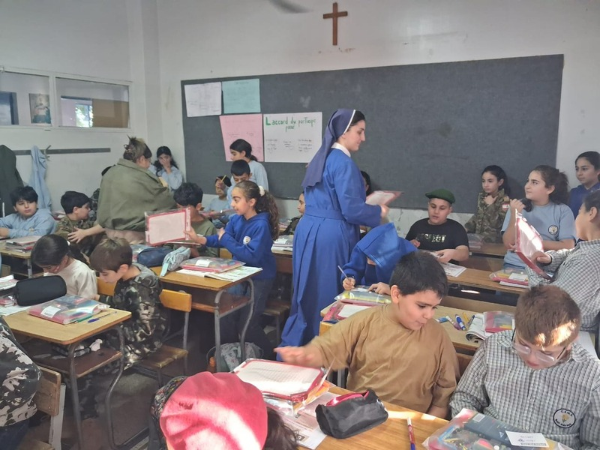
Pontifical foundation Aid to the Church in Need (ACN) has been helping schools across the Middle East stay afloat during these years of crisis.
In the Holy Land, Syria, and Lebanon, ACN is helping over 15,000 students to remain in over 200 different Christian schools. At the same time, almost 2,500 teachers are benefiting from financial aid from the foundation.
The vast majority of these schools serve not only Christians but also members of other religions, and are sometimes the only educational space which actively promotes coexistence and tolerance, thereby providing a fundamental service to the entire society.
Five years of support for Lebanese schools
Lebanon is the country which receives the most support for schools from ACN. In 2021, the small country was going through a terrible financial crisis, following the collapse of the banking system. Many families lost their savings and were no longer able to afford the tuition fees for their children.
To help prevent the collapse of the whole education system, ACN stepped in to help pay tuition fees for close to 13,500 students and salaries for over 1,000 teachers across around 170 schools.
At the time, Marielle Boutros, who coordinates ACN projects in Lebanon, already feared the situation could get worse, but was far from imagining it could get as bad as it did.
“The situation five years ago was really very bad, and we had little hope for the future. If you’d asked us, we’d say we didn’t know how things might be in a further five years. But we didn’t imagine that it would go this far,” she explains.
In that time, Lebanon suffered two wars, with Israel launching air strikes in several parts of the country and even invading the south.
“In 2024, we had displacement, and in the south of Lebanon, people were not able to pay tuition fees; many of them lost access to their agricultural fields. But the 2026 war has been worse, because some damages are irreparable. It’s not that people don’t have access to their lands; it’s that there is nothing to go back to.”
Naturally, the situation has affected the schools as well. “Some have continued to teach online, and some have reopened since the ceasefire. But the ones in more dangerous areas don’t risk it, because there are still airstrikes in the south. And then there are some schools that don’t have any students, because they have all left and are scattered over the country.”
In this context, ACN’s support for schools is more important than ever. “We are still in a state of war, and nobody knows what is going to happen. If you are a parent, even in a safer area, you are not going to spend the little you have on tuition fees when you can’t be sure if you will have the money to feed your family.”
“And then we have the schools in the affected areas. The teachers have to be paid, in order to maintain their link to the school and avoid losing them, because we don’t have a pool of talented teachers as we did before, due to emigration,” Boutros adds.
Boutros also oversees ACN projects in Syria, where, she says, the situation remains “stable,” but not in a good way. “The general feeling in Syria is of uncertainty, and uncertainty has become the new stability. It hasn’t turned into positive things or negative things yet.”
“But the economic situation is very bad, and it is important that we understand that Syria is not out of the crisis yet,” Boutros explains.
State pressure
The situation for schools in the Holy Land is also particularly sensitive at the moment. Christian schools in East Jerusalem, for example, have come under great pressure from the Israeli government. In January, the government passed a law banning new teachers with diplomas from West Bank universities from teaching in schools in Israel.
More recently, dozens of teachers who live in the West Bank did not have their permits to enter Israel renewed. Christian schools in Israel declared a strike, leading the government to relent and to renew the permits, although in some cases for only a few weeks.
The Christian churches in the Holy Land have a strong network of schools, which often serve Muslim students as well. The Latin Patriarchate of Jerusalem, for example, runs 43 schools, 35 kindergartens, 12 schools in Palestine, 24 in Jordan, and 6 in Israel, which serve around 20,000 students, including 6,000 in the West Bank and Gaza. ACN support goes especially to the poorest members of the Christian community, to allow them to have access to an education of excellence that also helps them to maintain their religious values.
Between 2025 and 2026, Aid to the Church in Need (ACN) provided about $2.9 million in support for schools and education-related projects in Lebanon, Syria, and Palestine. Lebanon received the largest share, with about $1.8 million, while over $650,000 was allocated to Syria, mainly for emergency support to schools, as well as stationery. More than $480,000 was provided for the Holy Land.
– Filipe d’Avillez


