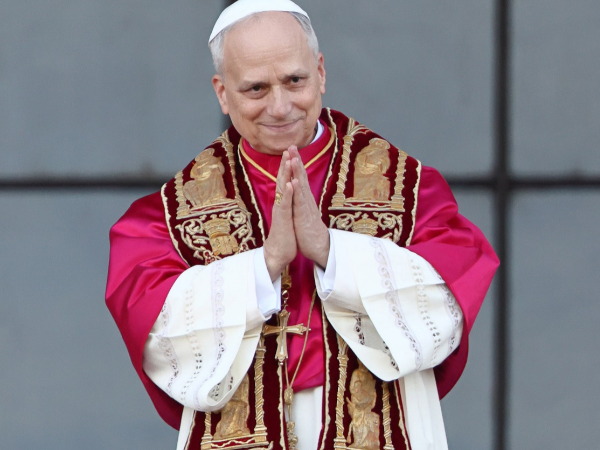
The bishops of Uruguay, Argentina, and Peru do not hide their excitement over the upcoming visit of Pope Leo XIV, scheduled from November 6 to 17. Leo will be visiting three countries, and ten cities. He begins his journey in Uruguay, leaving on November 8 for Argentina. From November 11 to 16, he will be in Peru, arriving back in Rome on November 17.
During an online conference organized by pontifical charity Aid to the Church in Need (ACN), three bishops, one from each of the host countries, spoke about the specific realities and challenges Leo XIV will find when he arrives.
Cardinal Daniel Sturla, the Archbishop of Montevideo, in Uruguay, explained that his small country stands in contrast to the rest of Latin America, being the most secularized.
“Over the past century, since 1929, Uruguay has gone through a period of strong secularism. Only 33 percent of Uruguay’s 3.5 million people identify as Catholics; 28 percent believe in God but do not belong to a specific church; and another 28 percent are agnostic or atheists, with 11 percent claiming a different religion.”
This leads to peculiar phenomena. “For example, we kept Christian celebrations, but they were given different names. Christmas is the Day of the Family, and Easter is the Week of Tourism.”
In this environment, he said, “the Church is free to operate, but it occupies a secondary place. Our Church is poor and small, but free and beautiful. Being a priest here is a service offered with modesty. There is no prestige attached, which leaves the priest free to lead a normal life and be devoted to his tasks.”
“We are waiting for the Pope with much hope and love, and closely cooperating with the state,” the Cardinal told those who attended ACN’s conference.
Argentina focused on youth
Even though Pope Francis was Argentinian, it has been almost 30 years since the country last received a Papal visit.
Auxiliary bishop Alejandro Musolino of Cordoba, in Argentina, says the local Church is expecting a massive turnout of youths, and wants to give them the best opportunities to meet the Pope.
“We just had the 52nd youth pilgrimage to Our Lady of Luján, on the first weekend of October, and around 2.8 million people participated. We need to make it possible for all the young people to meet the Pope, so we are having three large outdoor masses: one in Buenos Aires, another in Córdoba, and another in Luján.”
The bishop, who is also on the National Bishops’ Commission for Youth, said he can sense “that there is a positive feeling there, young people who are not finding truth in globalization or on social media, and are trying to find a purpose in life and in faith.”
“During the pandemic we hit rock bottom in many respects – including young people’s mental health. Today, spiritual strength is a source of hope. Above all, the fact that the Church created spaces where young people can take the lead seems to have helped them feel they belong, that their voices matter, that their actions matter, and that the missionary spirit is vital. It seems these are key aspects that are coming to the fore, and we want to continue nurturing them so that they may flourish.”
Argentina has a population of close to 46 million people, of whom approximately 63 percent are Catholic.
“He is coming home…”
Perhaps the greatest excitement over this trip is being felt in Chiclayo, the diocese of which Pope Leo was bishop of for eight years when he lived in Peru. His successor, Bishop Edinson Farfán, knows he faces different challenges from his colleagues in Argentina and Uruguay.
“He is coming home when he comes to Peru. We don’t need to introduce the country to him; he knows everything about the Peruvian Church,” he told the ACN conference.
Bishop Farfán believes the Pope will be perfectly equipped to address the specific problems of a country in which close to 80 percent of the 35 million inhabitants identify as Catholic.
“The first thing he will do is convey a message of communion, building bridges, dialogue, and encounter. This will be one of the most important topics. In all his speeches, he will speak about communion, and as a good Augustinian, when he does so, his message will be grounded in the Trinitarian mystery.”
“He will also talk about the Amazon – in fact, he will be the first Pope to celebrate Mass in the Peruvian Amazon. Peace is also a very important topic to him, and he will encourage us to work for peace, and he will speak about the problems the country has, such as the struggle against corruption and organized crime, and efforts to strengthen democracy,” the bishop concluded.
Pope Leo has just undergone surgery to remove a malignant nodule on his lung. The Vatican has said that the planned trip to Latin America remains on the agenda, but all the bishops who spoke made it clear that the first priority should be his health.
“We are looking forward to this visit with much hope and joy. We hope the Pope will feel better soon; we pray for a speedy recovery; and we hope that he enjoys his visit, because we are going to enjoy his being here,” said the auxiliary bishop of Cordoba.
“But we want him to enjoy us also, and to confirm us in the faith, and for that, we want him to come in good health, and when he feels up to it.”
A continent of vibrant faith
The continent Pope Leo will be visiting is one of the most vibrant in terms of Catholicism in the modern age.
During the press conference Luis Vildoso, ACN’s director of projects for Latin America, provided some context on the upcoming visit. “About 48 percent of the world’s Catholics are located in the Americas, and this region also has 72 mission territories, which is higher than any other region where the Church is present. Of these, 18 are located in a single country — Peru — which has 10 territorial prelatures and 8 apostolic vicariates.”
“Regarding priests, in Latin America, a priest has to care for or accompany 7,500 Catholics, whereas in Africa, which is another continent experiencing a great flourishing, that number is much lower, as it is in the United States. In Cuba, a priest has to accompany an average of 20,000 faithful, and in Honduras, 14,000. Compounding this reality are the vast territories, huge distances, the Andean region, the Amazon, and major cities — all of which lead us to recognize that this remains a priority region. The Church in Latin America has a crucial role to play and a vital contribution to offer to the universal Church,” Luis Vildoso explained.
From 2021 to October 2026, ACN allocated more than $15 million to support the Church in Peru, Argentina, and Uruguay. During this period, the foundation funded 903 pastoral projects, including assistance for the sustenance of priests and religious; formation programs; the construction and renovation of Church infrastructures; Mass stipends; religious literature; and means of transportation for pastoral work. Of the total aid provided, more than $8 million was allocated to Peru, nearly $5 million to Argentina, and more than $1.7 million to Uruguay, helping to strengthen the Church’s mission in some of the most vulnerable and remote regions of these countries.
– Filipe d’Avillez