Following her recent visit to the Holy Land, Regina Lynch speaks about the challenges facing local Christian communities, the importance of supporting their livelihoods and faith, and why Christians around the world should not forget the land where the faith was born.
You returned from Holy Land just a few days ago. What made the strongest impression on you during your visit?
What really brought the situation home to me was meeting Christian families in Bethlehem and in the Old City of Jerusalem, some of whom benefit from small job creation projects funded by ACN’s benefactors.
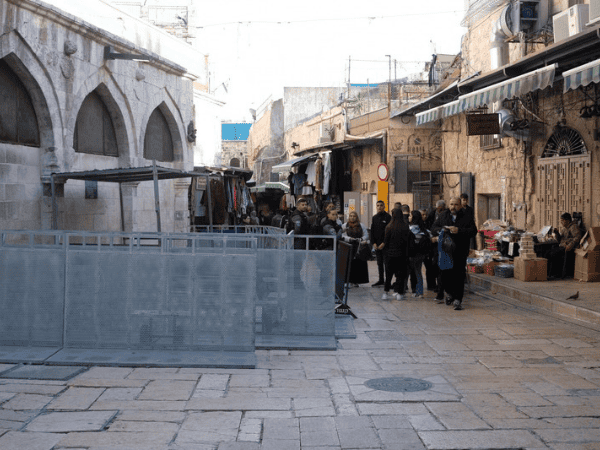
These are people who want to work and provide for their families. We met women whose husbands had already sold whatever they could sell, and yet they still did not have enough to support their families. That really showed me how desperate the situation has become.
You had visited the region before, hadn’t you?
Yes, but it had been quite some time, and a lot has changed. The most noticeable difference was how few pilgrims there were.
For us, it was wonderful to visit the Holy Sepulcher and the Church of the Nativity without the huge crowds. But for local Christians, the absence of pilgrims has serious consequences. Many depend on pilgrimage tourism as guides, shopkeepers, or artisans. What is pleasant for the visitor can be devastating for the people who live there.
What was the purpose of your visit?
Following an appeal by Abbot Nikodemus Schnabel of the Dormition Abbey, who encouraged people to visit precisely because so few pilgrims were coming, we saw the trip as an opportunity to show solidarity with the local Church, better understand this very complicated situation and see what ACN can accomplish thanks to its benefactors. It was also a pilgrimage. We prayed together and visited the places where Christ walked 2,000 years ago.
You also had the opportunity to meet the Latin Patriarch of Jerusalem, Cardinal Pierbattista Pizzaballa. What was the main message he wanted to convey?
Cardinal Pizzaballa expressed his deep gratitude for ACN’s support and emphasized that it is not only financial: the prayers and concern of our benefactors are equally important.
He also stressed the importance of strengthening Christians in their faith. We often speak of them as the “living stones” of the Holy Land. Helping them find employment and remain in their communities is essential, but so, too, is helping them understand their responsibility to preserve and pass on the Christian faith in the land where Christ died and rose again.
You also visited communities in the West Bank, where tensions and reports of settler violence have been making headlines. Did you feel safe during your visit?
We visited Christian villages, including Taybeh, where the atmosphere inside the villages was quiet and beautiful. But we could see settlements expanding closer to the villages, and local people explained how difficult everyday life has become.
The checkpoints in the West Bank make everything unpredictable. A teacher told us that some students leave home at six in the morning and do not return until six in the evening, simply because they have to travel elsewhere to continue their education and cross through different checkpoints.
Farmers were also worried about reaching their land and harvest in their crops. We had heard reports of olive trees being burned, which is particularly serious because olive cultivation provides an income for many families, and replacement olive trees need 10 years before they yield olives.
Turning to ACN’s support for the local Church, are there any particular projects you would like to highlight?
One was the Catholic printing press in Bethlehem, which produces religious and educational materials for the Latin Patriarchate, schools, and religious congregations. ACN helped upgrade its equipment. The Church faces more and more difficulties finding printing companies willing to publish Christian materials, so having its own press is particularly important. It is a very practical project because it both serves the Church and creates employment for local people. The press serves the Latin Patriarchate, schools, religious congregations, and other institutions. It is a practical example of how support can strengthen both the Church and the local economy.
The other project that really encouraged me was the seminary in Beit Jala that is home to both the minor and major seminarians. The latter shared with us about their call to the priesthood in this war-torn corner of the Middle East. ACN has supported the seminary for some time, including assistance with improving its buildings.
We also met three laypeople there who were participating in a spiritual formation program organized by the Latin Patriarchate. Many of the participants had lost their jobs and could no longer work as tourist guides because so few pilgrims were visiting.
The program helps them deepen their knowledge of the Christian faith so that, when they are able to return to work, they can explain the holy sites to pilgrims from a Christian perspective. Other courses for professionals are being offered.
One participant told us that he could now refer to specific passages of the Bible when explaining the places pilgrims visit. A woman shared something equally moving. She said that before the crisis, her family sometimes went to church on Sundays. Now, she and her family had grown much stronger in their faith.
That was uplifting. Even amid suffering and uncertainty, people can grow in their faith and discover a renewed sense of community. For me, this is a reminder that even amid suffering and darkness, there can be light. People can grow in their faith, find hope, and become stronger together.
After everything you have seen, how serious would it be if Christians could no longer remain in the Holy Land, where Christianity was born?
It would be a complete disaster. As Christians, wherever we live, we are connected to the roots of our faith. The Holy Land is where our faith began. To see the Christian presence disappear from the land where Christianity was born would be devastating.
Christians there need to know that they have not been forgotten. Since returning, I have been encouraging people to visit the Holy Land. It is not only a pilgrimage to sacred places; it is also a very practical way of supporting local Christians who depend on visitors for their livelihoods and letting them know that they are not alone
Some people may think it is too risky, but personally, I did not feel in danger at any point during the visit.
So my message is simple: pray, support, and visit.
– Maria Lozano