
ACN has committed to a second aid package, which, according to its executive president, will be “much higher than the initial grant.
The Church has been present in the streets of La Guaira and Caracas, to care for and accompany the thousands of victims of the double earthquake that wrought great destruction in Venezuela on June 24.
In a press conference organized by Aid to the Church in Need International (ACN), Archbishop Raul Biord Castillo, S.D.B., of Caracas said that even though many Church structures had been damaged, clergymen, religious and faithful have been tireless in responding to people’s needs.
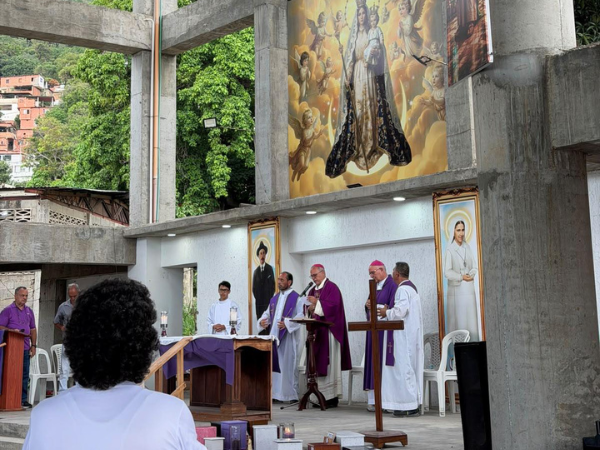
“As Christians, and as [the] Church, we have been present in the street since Day One. We have over 35 damaged churches and Church buildings in La Guaira and Caracas, but the Church is more than buildings, and we are present in the streets, visiting the people and taking consolation to hospitals, food to the tents, and celebrating the sacraments in the street, with the people.”
As an example of this solidarity, the archbishop mentioned the seminarians from Caracas and its suffragan dioceses, who have been out in the streets every day, “accompanying the people in the streets, the broken-hearted who have suffered so much.”
The Church continues to distribute material, medical and food aid, namely through Caritas, which has proven to be one the most reliable institutions working in the country, but Archbishop Biord insists that the people need more than just material help.
“It is also important to take consolation and spiritual aid. There are some very tough stories and people are grateful when the priest or deacon arrives, as they feel it makes God present. Recently, someone commented to me that since the earthquake, even atheists believe in God,” said Archbishop Biord.
A month after the earthquakes, official figures still put the dead at between 4,000 and 5,000, but the magnitude of the tragedy is much greater. “Between 20,000 and 30,000 people are still missing, and an even greater number have lost their homes. In places like La Guaira, where people mostly work in tourism or at the port, those whose homes remain standing have lost their jobs. Many people are living in makeshift tents, and it is winter here, which means heavy rain.”
As talk begins to turn to rebuilding, Archbishop Biord says that the trauma of the survivors also needs attention. “First, we need to rebuild lives and stories. Later, we can rebuild infrastructure, starting with hospitals and schools, because life goes on and kids need to go to school and the sick need to be tended to,” he said. “As a Church, we are at the service of our people, to accompany them in their sorrow and their trauma.”
The Church realizes that at this moment, it is essential also to continue to care for those who are on the frontlines — priests, deacons, religious and lay volunteers.
“We can feel the catholicity of the Church, because we are a family,” said the archbishop. “We are a family to those who have lost their families. And we also feel the solidarity from those offering us concrete aid, such as ACN. Now, our priority is to help priests, religious sisters, deacons, ministers of communion, all those who are serving the Church directly, especially from La Guaira, who lost their homes and family. We need to care for our carers. They need to be strong to support those they visit. Our first priority is to support them with our presence.”
One of the key roles of these caretakers at the moment is to help survivors deal with their personal and family losses and give the dead a dignified burial. This is difficult when many corpses are still under 13 stories of rubble.
On the other hand, Archbishop Biord believes the tragedy has allowed many people — including in government — to see the Church in a different light, recognizing its unique ability to provide aid where it is needed most.
“The government has permitted the Church to access places and distribute aid. Caritas is recognized and respected in this process, and is very valued as a coordinator of help. We can accept aid, and we continue to do so, in a coordinated way, though we know that the greatest responsibility falls on the state. More than political divisions, we need to think of the victims and rebuilding,” said Archbishop Biord.
Auxiliary Bishop Carlos Eduardo Márquez Delima of Caracas also spoke, and described what the Church sees as its main mission at this time. “We are trying to be agents of Heaven in Venezuela,” Bishop Márquez said. “When people talk to us, when they see us helping people, we want to convey a message of hope and show them that God does not abandon us. He is with us and He walks with us. … We might not be able to rebuild buildings, but we can be the hands and voice of God to convey hope to our people.”
When the tragedy first struck Venezuela, ACN pledged $113,764 (100,000 euros) in immediate support. The foundation’s executive president, Regina Lynch, said in the press conference that more help is on the way.
“A delegation from our project department will travel to Venezuela soon and meet with the Church there to listen to them,” she said. “By then, they will have drawn up a list of priorities, and it will be easier for us to announce the next package, which will certainly be much higher than the initial 100 thousand [euros].”
Said Lynch, “The road ahead is very long. There is so much to be done. It’s very important that we do not forget Venezuela.”
– Filipe d’Avillez


