
Venezuela is in mourning. Pain is everywhere, and the Church is often the only source of hope.
At the entrance to the Church of Our Lady of Candelaria on Venezuela’s Caribbean coast, people are greeted by a poster with three lists: the dead, the missing, and the rescued.
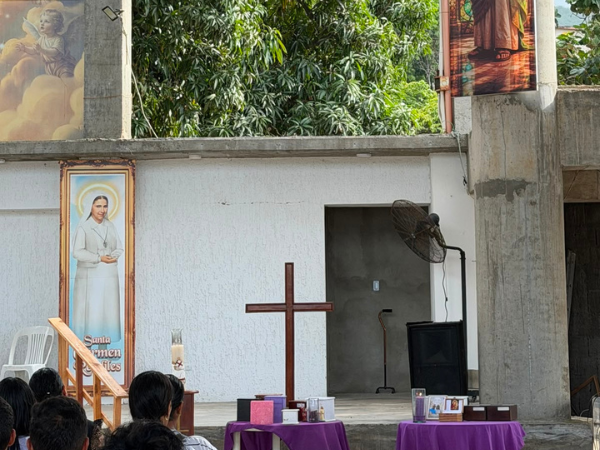
The church, in the city of Caraballeda, is under construction and does not have walls or a ceiling yet. And yet, the church fills every day — with the living and the dead.
During a visit from Aid to the Church in Need this week, 13 wooden boxes sat on two tables draped in violet. They contained the ashes of victims extracted from the rubble left by back-to-back earthquakes that struck Venezuela on June 24. This one contains Daniel’s wife, that one has Gloria’s twin sister. There are the parents and sisters of a young girl — two friends helped her carry in the urns.
Bishop Pablo Modesto González Pérez, S.D.B., of the Diocese of La Guaira points to one box containing the ashes of an altar server. She carried his crozier during Mass on the Solemnity of St. John, not long before the 7.2 and 7.5 magnitude quakes struck.
“So many people, so many friendships gone,” said Fr. Daniel Acosta, the parish priest of Tarmas. “It hurts badly when you realize that somebody you knew your whole life has gone, after years of sharing everything with them.”
Fr. Acosta, who lost his own home, speaks about mixed feelings among the local populace and the priests who are present to accompany, console and support the grieving and the struggling.
“In the morning, we fill ourselves with His strength, with God’s spirit, to better serve our communities,” the priest said. “But at night, the heart sinks, and since we are merely human, the tears flow.”
Fr. Laudence Betancourt, pastor of Our Lady of Candelaria, told ACN that the church is not normally used for daily Mass, as construction remains incomplete. But now, five times more faithful come to seek consolation.
Identifying bodies in the morgue
Stories of loss and grief abound. One young girl received a call from the parents of a friend. They were in hospital, because of the earthquake, but had no news of their two daughters. They asked her to check the morgue. After viewing 200 bodies, she found the two sisters — as well as another friend.
For his part, Fr. Betancourt spent 10 days visiting a spot where a search was underway for parishioners’ children. The search party eventually gave up hope of finding the 23- and 16-year-olds alive, but they wanted the priest to be there to pray for them before they took the bodies away. On the last day, Fr. Betancourt was there for 12 hours, until 2 A.M., when they finally extracted the two victims. At 6 A.M., he was being called to go to another building, to pray over yet another body.
One of the worst affected parishes is that of St. Óscar Arnulfo Romero in Ciudad Chavez. Fr. Alfredo Bustamante, the parish priest, tells ACN that “this was a young parish, but it has been practically destroyed. Around 80% of the faithful have died. We lost entire families, grandparents, parents, children, and grandchildren. Only four members of our choir survived, and I lost four of my altar servers. It has been hell.”
Ciudad Chavez had a population of 22,500 people. The number of dead is still unknown, but all the residents have lost their homes, including Fr. Bustamante. Some have collapsed, others are twisted like cardboard boxes, and others burned. It looks like a war zone or a ghost city. As well, many people lost their jobs, as La Guaira depended mostly on tourism, the port, and the airport — all now severely disrupted.
The only thing left standing is the shrine to St. José Gregorio Hernández, a Venezuelan doctor who cared for the poor and who will now have to intercede to heal the wounds of so many. His statue, which was on a pedestal 10 to 13 feet high, landed on its feet, as if to show the suffering Venezuelan people that he is there for them.
But, as Fr. Alfredo points out, “If you look into [the statue’s] eyes, you’ll see that he looks sad.”
Miracles
If St. José Gregorio is known for his miracles, the past two weeks have also suggested that this has been a time of miracles as well as tragedy. In spite of a terrifying and growing death toll (it was up to 3,800 by Friday afternoon), many were also saved from near-apocalyptic destruction. During a sermon in the Church of Candelaria, Bishop Modesto spoke about the miracle of surviving. He also thought that he was about to die after seeking refuge under a door frame, during the first earthquake, and he heard a brutal, voracious roar.
He later learned the noise had come from the collapse of five buildings next to the seminary. With great difficulty, he managed to get out. Several walls had collapsed, but none of the 16 seminarians suffered serious injury.
“But in the end, it’s the miracle of why we made it but others didn’t,” Bishop Modesto reflected. “It’s difficult to understand, but these are things we need to ponder in our hearts, like Mary, and to realize that if God gave us the gift of life – and it was a gift – it is so that we can live in service to others and not just give up. The question is not why I am alive, but what for.”
Many of those who are consoling, helping in the support centers, working with Caritas, and cooperating with parishes have also lost family, friends, home, and work. They welcome ACN with hugs, gratitude, and with a smile. They share what they have. This is the other side of mourning, the faith of those who, despite the pain, are serving their neighbors. It is a resilient and grateful faith. It is the great witness of what the little Diocese of La Guaira has to give the universal Church.
– Maria Lozano


