
In one of the poorest and most densely populated communities in Caracas, the Church has mobilized to care for the wounded from La Guaira. ACN has approved an emergency aid package of $113,828 to support the Church’s response to the catastrophe.
When Venezuela was struck by deadly earthquakes recently, Bishop Juan Carlos Bravo Salazar of Petare was in Merida, over 300 miles away. With all flights canceled, he had to embark on a 16-hour trip by land back to his diocese. He arrived to an unexpected sight.
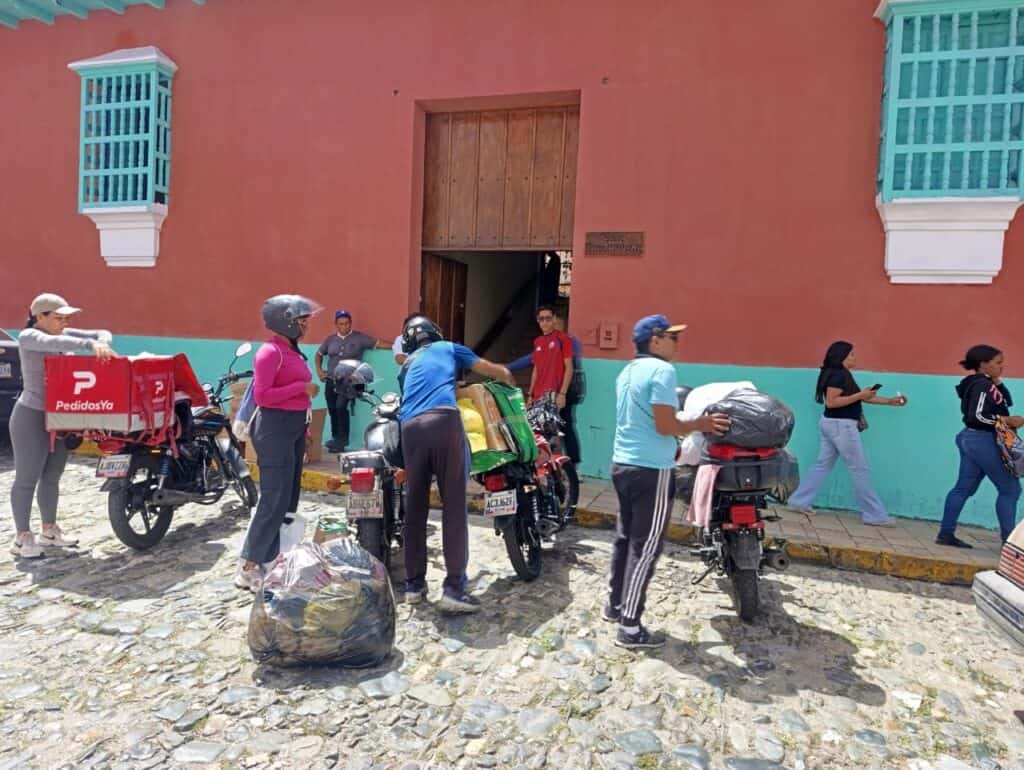
“Petare is one of the poorest and most densely populated areas of Caracas,” the bishop told pontifical foundation Aid to the Church in Need (ACN). “They call it Latin America’s largest slum. You’d think that the poorer neighborhoods would be the first to collapse in an earthquake, but Petare remained intact.”
The Diocese of Petare covers 68 square miles to the east of Caracas and is home to about 2 million people, distributed among 2,000 neighborhoods. “We had no deaths or wounded as a direct consequence of the earthquake, because we have solid rock beneath us. But we did suffer some structural damage in churches, chapels, rectories, and some houses.”
“Around 90% of our diocese is poor,” Bishop Bravo explains. “But this emergency turned Petare, which is a vulnerable area, into a key launchpad for help to the wounded in La Guaira,” the region that was hardest hit.
Petare is also home to four of the country’s main hospitals, and so has been receiving the lion’s share of the wounded. That is why the local Church has mostly focused on providing aid to the hospitals, where a shortage of medical supplies has made an already precarious situation worse.
Through the diocesan branch of Caritas, the Church in Petare set up four collection centers and has mobilized over 250 volunteers. “We are providing medication, surgical equipment, cleaning materials, and food, but also clothes, because many of those who arrive come with nothing at all.”
The bishop highlights that “the generosity of the people has been enormous, a true blessing of God. Their willingness to help, to work together, to be present, to sort out clothes and medicine, or just to transport and carry the aid has been admirable,” he explains. “We can see God’s footprints and his presence in all we are doing.”
Love breaks down fear
Bishop Bravo recalls one woman who arrived from La Guaira. She had family members in the hospital there, but she was confused, lost, and did not know where to obtain medicine, medical exams, or clothing. The volunteers who accompanied her managed to get her everything she needed, and remained with her. At one point, she collapsed. “We thought she had died,” Bishop Bravo explains. Doctors, paramedics, and some young people rushed to her aid.
“But then, between tears, laughter and relief, we realized what had happened. It wasn’t just accumulated exhaustion or fear. She told us that she had felt overwhelmed with gratitude at having been welcomed and helped in this way, in an unfamiliar place, and by people who expected nothing in return. Fear can break a person, but love breaks down that fear.”
Petare came to the aid of the victims. “The poor never cease to surprise us,” Bishop Bravo explains.
“The poor are the greatest treasure of the Venezuelan Church,” he stresses, as he recounts yet another experience. “Two men came to us. They are cobblers: they collect old shoes, fix them, and sell them to make a living. They brought us 50 pairs of shoes they had fixed to sell, but instead decided to donate them to the people who had lost everything. Even those who have nothing give everything,” he says.
Bishop Bravo believes that this gesture reveals a deeper truth: God also works out of nothing. There may be hardly any resources, but there is no lack of human and spiritual wealth.
Another sign of hope for the bishop amid the crisis has been the youth. “Many of them have cooperated with us, unloading trucks, sorting clothes, preparing food, and transporting aid. One night, a large truckload of water, mattresses, food, and medicine arrived at one of the collection centers. It was late, and we had to call the youths to come and help. They didn’t hesitate, and in 15 minutes, we had the truck fully unloaded.”
“They help with joy, discipline, and without seeking attention. The most important thing for them is to be there as brothers, to accompany and help.”
Besides the material aid, the diocese has also been providing spiritual and human accompaniment to those who were affected by the earthquake, as well as to the volunteers and health workers. “We cannot focus only on psychological assistance; we need to provide spiritual help as well. But this doesn’t mean spiritualizing the experience. It means humanizing it, from the perspective of Jesus,” Bishop Bravo explains.
The Bishop of Petare has proposed three words to help his community experience this emergency situation: “prudence, calm, and patience.”
“In times like this, we have to be prudent to look after ourselves as well as others. We need to be calm, because one should not be rash in times of pain. And we need patience to begin a process that takes more than just a few days, because even if you want to speed things up, there are times when you need to know when and how to move ahead,” he explains.
ACN: Prayer, closeness, and brotherhood
ACN has approved an emergency aid package of 100,000 Euros ($113,828 US) to support the local Church’s response to the catastrophe. The goal is to allow for a more flexible response to the most urgent needs in the affected dioceses, both in terms of immediate care for the afflicted and in terms of pastoral, human, and spiritual support for the communities that were affected by the earthquake.
Above all, Bishop Bravo asks ACN’s friends and benefactors for prayer and proximity. “To us, ACN means to be able to count on brothers who are always willing to stretch out their hand to us,” he says. “More than asking for things, I would like ACN to continue with its charism and avoid becoming one more bureaucratic or social aid institution, instead of a community that generates brotherhood.”
– Maria Lozano


